If you need to fix a sluggish computer, understanding the difference between “slow” and “sluggish” is crucial. A sluggish computer doesn’t just take a long time to load; it stutters, hangs for milliseconds when you drag a window, and responds to your typing with a noticeable delay. It feels like moving through mud. This “micro-lag” is usually not a hardware failure but a symptom of System Latency caused by conflicting drivers, unoptimized visual effects, or a bloated Windows registry. This guide explains how to fix a sluggish computer by tuning the operating system for maximum responsiveness.
Quick Fix to Fix a Sluggish Computer (1 minute)
Eliminate UI lag instantly with these responsiveness tweaks to fix a sluggish computer:
- Disable “Transparency Effects”: Go to Settings > Personalization > Colors. Turn OFF “Transparency effects.” The “acrylic” blur effect is extremely heavy on the GPU and is a common reason you need to fix a sluggish computer.
- Adjust for Best Performance: Press Win + R, type
sysdm.cpl, hit Enter. Go to Advanced > Performance Settings > Select “Adjust for best performance.” - Set High Performance Power Plan: Control Panel > Power Options > High Performance. This prevents the CPU from downclocking to save power.
- Updating Graphics Drivers: Sluggish UI is often a GPU driver issue. Download the latest GeForce or Radeon drivers directly from the vendor (don’t trust Windows Update).
- Clear Temp Folder: Press Win + R, type
%temp%, delete everything. A folder with 50,000 files slows down file explorer indexing.
If the sluggishness persists after turning off visual effects, you likely have a deeper DPC Latency issue that requires more advanced steps to fix a sluggish computer.
Symptoms Checklist
Confirm you are dealing with “Sluggishness” (Latency) rather than just “Low Speed”:
- The mouse cursor jerky or skips pixels.
- Typing feels “heavy” (letters appear slightly after you press keys).
- Dragging a window leaves a “trail” or stutters.
- Right-clicking on the desktop takes 2-3 seconds to show the menu.
- Audio crackles or pops when you open new programs.
- YouTube videos drop frames even though internet is fast.
Troubleshooting Summary (Fast Diagnosis)
| Symptom | Likely Cause | Best Fix |
|---|---|---|
| Mouse Lag / Stutter | Polling Rate / USB Interferance | Change USB Port / Lower Hz |
| Window Dragging Lag | DWM (Desktop Window Manager) | Disable Transparency |
| Right-Click Delay | Bloated Context Menu | ShellExView Cleanup |
| Typing Delay | Keyboard Filter Keys | Disable Filter Keys |
| Audio Popping | DPC Latency (Drivers) | Update Realtek/Wi-Fi Drivers |
Why This Happens
A sluggish feel is usually caused by Interrupts. Your CPU handles thousands of requests per second. If a badly written driver (like for a Wi-Fi card or RGB keyboard) takes too long to respond, the CPU “pauses” everything else—including your mouse cursor update—to wait for it. This creates micro-stutters.
Additionally, modern Windows uses DWM (Desktop Window Manager) to render every window as a 3D texture. If your integrated graphics card is weak or the driver is outdated, simply moving a window becomes a heavy 3D workload, making the interface feel sticky. Understanding these causes is essential when you fix a sluggish computer.
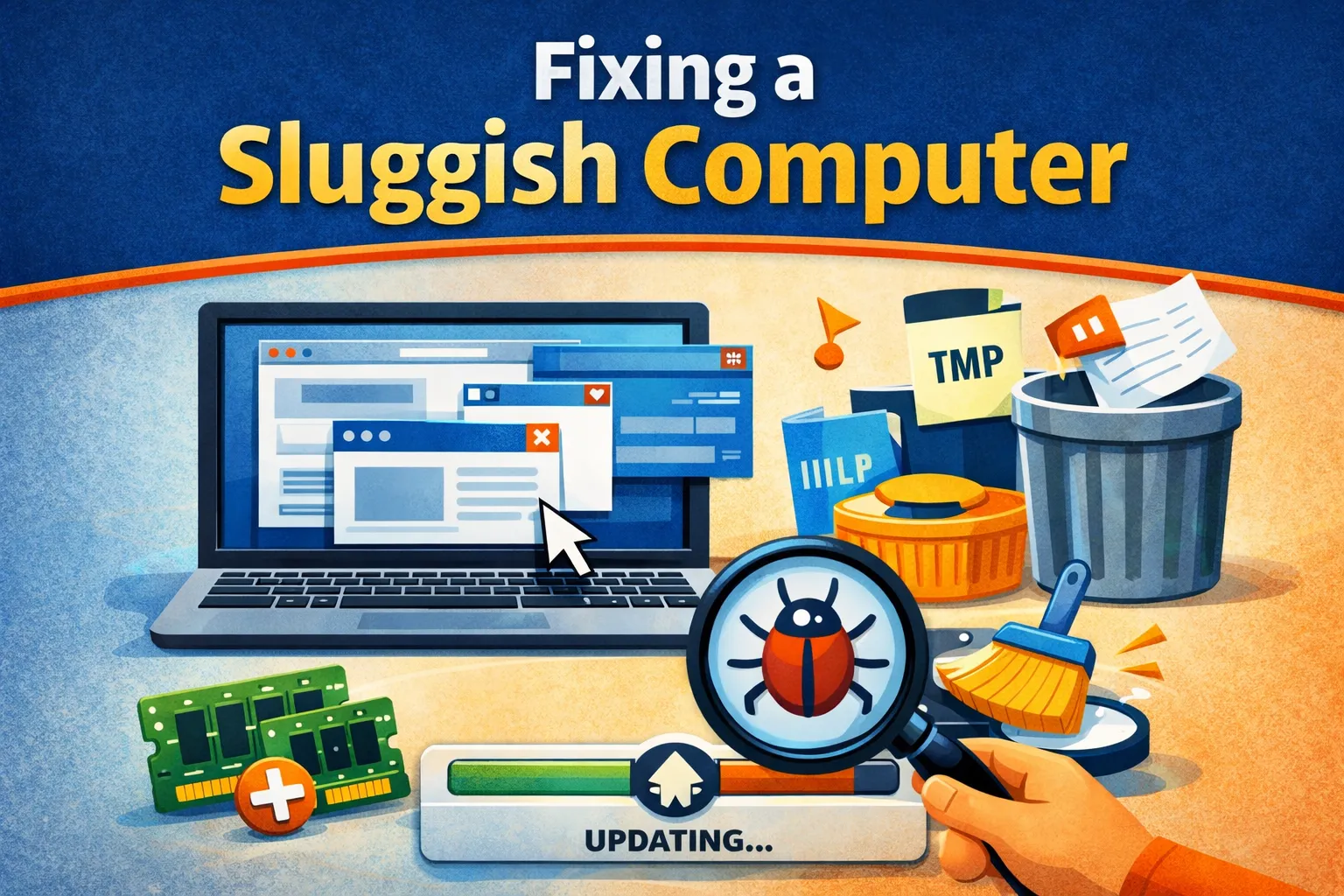
Fix Method 1: Optimize Visual Effects (The UI Snap)
What This Method Fixes
Removes the “fade” and “slide” animations that make Windows feel slow, making every click instant when you fix a sluggish computer.
- Press Win + S, search for “Adjust the appearance and performance of Windows.”
- Select “Custom”.
- Uncheck the following (Heavy items):
- Animate windows when minimizing and maximizing
- Animations in the taskbar
- Fade or slide menus into view
- Show shadows under windows
- Keep Checked (Essential for text quality):
- Smooth edges of screen fonts (ClearType)
- Click Apply. Windows will look slightly flatter but feel 2x snappier.
Fix Method 2: Resolve DPC Latency (The Hidden Killer)
What DPC Latency Fixing Does
Identifies if a specific hardware driver is causing the CPU to hiccup. DPC Latency is one of the most common hidden issues when you need to fix a sluggish computer.
- Download Latencymon (Free).
- Run the tool and click the “Play” button.
- Let it run for 2 minutes while you use the PC.
- If the bars turn Red, look at the “Drivers” tab.
- Sort by “Highest Execution Time.”
- Common culprits:
ndis.sys(Network/Wi-Fi) ornvlddmkm.sys(Nvidia). - Fix: Uninstall that specific driver in Device Manager and let Windows reinstall a generic one, or update to the absolute latest version.
Fix Method 3: Debloat the Context Menu
What Context Menu Debloating Fixes
Fixes the 3-second delay when you right-click files (caused by too many “Add to…” entries).
- Download ShellExView from NirSoft.
- Open it (Right-click > Run as Administrator).
- Go to Options > Filter by Extension Type > Select “Context Menu.”
- Look for entries highlighted in Pink (Non-Microsoft extensions).
- Disable items you don’t use (e.g., “WinZip,” “Nvidia Control Panel,” “Dropbox”).
- Restart Windows Explorer (or restart PC).
- Right-click is now instant.
Fix Method 4: Turn Off “Game Mode” and Background Recording
What Disabling Game Mode Fixes
Windows constantly records the last 30 seconds of your screen for “Instant Replay,” which adds input lag. Disabling this is a simple way to fix a sluggish computer during gaming or intensive tasks.
- Go to Settings > Gaming > Captures.
- Turn OFF “Record what happened” (Background Recording).
- Turn OFF “Record audio when I record a game.”
- Go to Game Mode tab and toggle it OFF (Paradoxically, Game Mode sometimes causes stuttering in desktop apps by de-prioritizing them).
Fix Method 5: Disable “Fast Startup” (The Pseudo-Reboot)
What Fast Startup Disabling Accomplishes
Windows “Fast Startup” prevents the kernel from fully resetting during a shutdown, accumulating errors over weeks.
- Open Control Panel > Power Options.
- Click “Choose what the power buttons do.”
- Click “Change settings that are currently unavailable” (Admin shield).
- Uncheck “Turn on fast startup (recommended).”
- Click Save Changes.
- Restart your PC. The boot usually takes 5 seconds longer, but the system will be much fresher and responsive.
Fix Method 6: The SSD TRIM Command
What SSD TRIM Optimization Does
Forces the SSD to clean up deleted data blocks, restoring write speeds to factory levels. This maintenance step can significantly help fix a sluggish computer experiencing slow file operations.
- Open “Defragment and Optimize Drives” (Search in Start Menu).
- Select your C: Drive (SSD).
- Click Optimize.
- This sends the RETRIM command. It takes 5 seconds.
- Ensure “Scheduled optimization” is turned ON (Weekly).
Prevent This From Happening Again
- Install Minimal Drivers: When installing graphics drivers, choose “Custom Install” and uncheck extra bloat like “GeForce Experience” or “Radeon ReLive” if you don’t use them.
- Avoid “Theming” Tools: Apps like Wallpaper Engine or Rainmeter use CPU cycles every millisecond to animate your desktop. Use a static wallpaper for max speed.
- Keep C: Drive Clean: Once an SSD crosses 90% capacity, its controller struggles to find free blocks, causing massive stuttering. Regular cleanup helps you avoid having to fix a sluggish computer later.
Frequently Asked Questions
Why does my PC lag even though I have high FPS?
This is “Frame Time Variance.” Even with 100 FPS, if one frame takes 50ms to render and the next takes 5ms, it feels sluggish. V-Sync or G-Sync helps smooth this out.
Is “High Performance” power plan dangerous?
No. It just means your CPU won’t drop its voltage when idle. It uses slightly more electricity (maybe $5/year) but eliminates the lag spike that happens when the CPU has to “wake up” from low voltage.
Can a bad mouse cause sluggishness?
Yes. If a wireless mouse has a low battery or signal interference (USB 3.0 noise), the cursor will skip, making the whole PC feel slow. Try a wired mouse to verify.
Does “RAM Speed” matter when you fix a sluggish computer?
Yes. If you haven’t enabled XMP (Extreme Memory Profile) in BIOS, your 3200MHz RAM might be running at 2133MHz default speed, causing a bottleneck in responsiveness.
Official References
- DPC Latency and Audio Glitches – Microsoft Docs
- ShellExView – Context Menu Manager
- Manage Windows Startup Apps
Conclusion
Learning how to fix a sluggish computer is about tuning the machine for responsiveness, not just raw power. By disabling the “eye candy” transparency effects, fixing DPC latency issues with clean drivers, and debloating your context menu, you can make a 5-year-old PC feel snappier than a brand-new one that’s bogged down by default settings. When you successfully fix a sluggish computer, responsiveness is the ultimate reward—choose speed over shadows.
Visit https://truefixguides.com/ for more.