6 Critical Ways to Fix AI Hallucination Problems
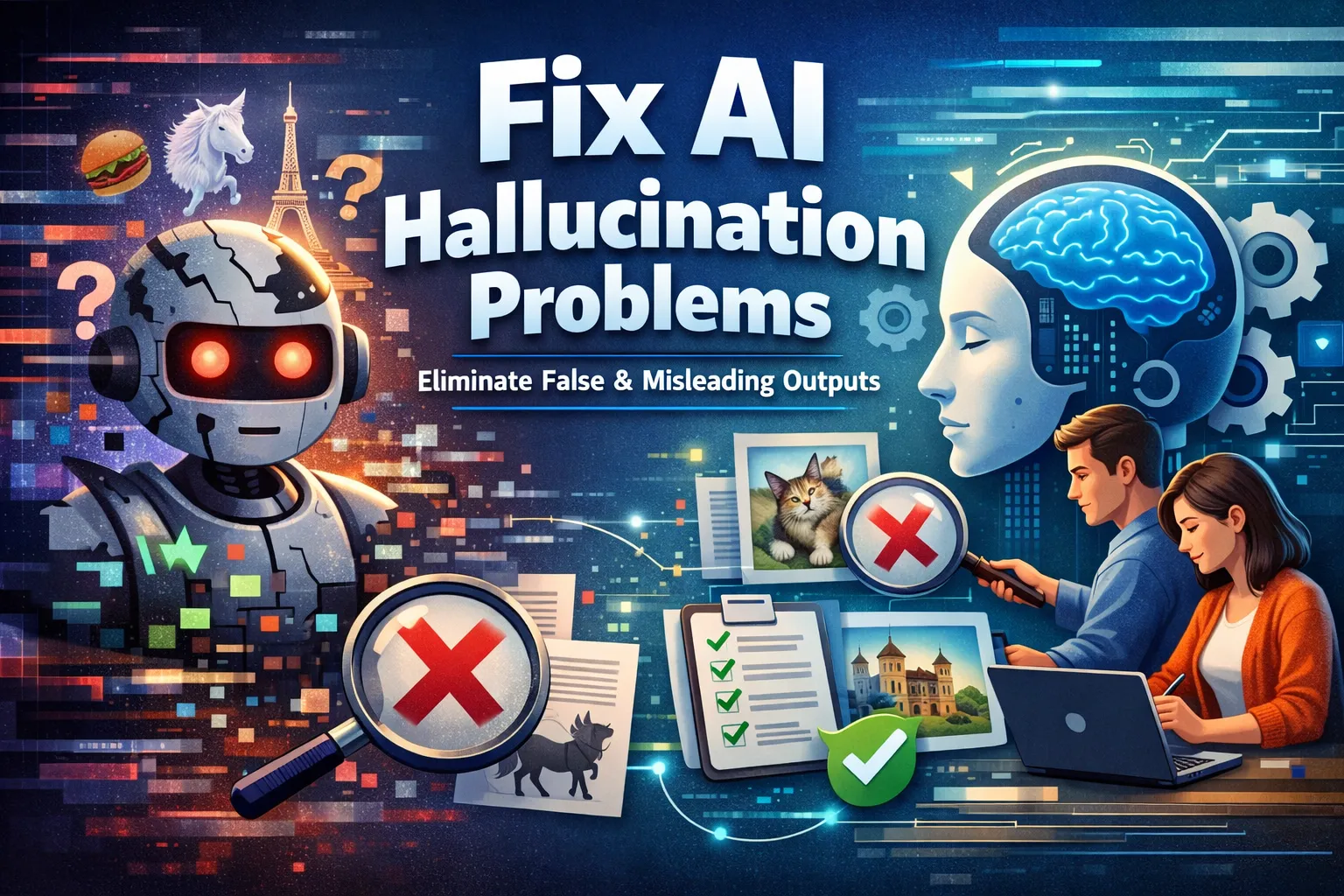
You ask your AI assistant for a simple fact, and it delivers a confident, detailed answer that is completely fabricated. This phenomenon — known as AI hallucination — is a critical flaw where models like ChatGPT or Gemini generate false information presented as truth.
Symptoms of AI hallucination include citing non-existent sources, providing incorrect dates or names, making up scientific data, or constructing logical but false narratives. These errors undermine trust and can have serious consequences in research, business, and decision-making.
The core issue is that these models are designed for linguistic fluency, not factual verification. Fortunately, you are not powerless. This guide details six proven methods to fix AI hallucination, restore accuracy, and regain control over your AI interactions.
What Causes AI Hallucination?
Effectively fixing AI hallucination requires understanding the root causes. These aren’t random glitches but systematic outputs stemming from how Large Language Models (LLMs) are built and function.
- Statistical Prediction, Not Knowledge Retrieval: LLMs don’t “know” facts — they predict the next most probable word based on patterns in training data. When faced with ambiguity or gaps, the model chooses a statistically likely sequence that sounds correct but is factually wrong. This is the fundamental engine behind confabulation and fabricated outputs.
- Incomplete or Biased Training Data: If the model’s training data is missing information, contains errors, or has inherent biases, it will replicate and amplify these flaws. A model trained on outdated medical journals will produce AI hallucination by presenting obsolete treatments as current fact.
- Overgeneralization and Pattern Matching: The model excels at recognizing and extending patterns. If it learns “Author X wrote Book Y,” it might incorrectly infer “Author X wrote Book Z” if the topics are similar — a pattern-driven form of AI hallucination that creates false citations with complete confidence.
- Vague or Leading User Prompts: Ambiguous, overly broad, or implicitly biased prompts can steer the model toward invention. Asking “Tell me about the famous achievements of the little-known inventor John Doe” pressures the AI into AI hallucination by generating achievements that may not exist.
These causes are not excuses but diagnostics. Each fix below directly targets one or more of these underlying failure points to reduce AI hallucination and force more reliable outputs.
Fix 1: Implement the Grounding Technique
This is the most powerful direct fix for AI hallucination. Instead of letting the model rely on its potentially flawed internal knowledge, you “ground” its response by providing the exact source text it must use. This forces the AI to act as a precise summarizer, eliminating its ability to invent.
- Step 1: Gather the verified source material you want the AI to use. This could be a research paper, a company report, a code snippet, or a transcript. Copy the relevant text.
- Step 2: In your prompt, explicitly instruct the AI to base its answer ONLY on the provided context. Use clear, commanding language: “Using ONLY the text I provide below, answer the following question. Do not use any outside knowledge.” This single instruction eliminates the most common source of AI hallucination.
- Step 3: Paste your source material directly into the prompt after the instructions. Clearly demarcate it with tags like [CONTEXT START] and [CONTEXT END].
- Step 4: Ask your specific question. The model’s response is now constrained to the information you supplied, dramatically reducing AI hallucination in the output.
After this fix, the AI’s answer should directly reference and paraphrase your provided text. If it introduces an unsourced “fact,” you can immediately identify it as an AI hallucination and refine your prompt or source material accordingly.
Fix 2: Use Iterative Prompting and Fact-Checking
Don’t ask for a final answer in one go. Breaking the task into steps forces the model to reveal its reasoning and sources at each stage, making AI hallucination visible before it becomes part of the final output.
- Step 1: Start with a meta-prompt. Instruct the AI: “We are going to tackle this question in steps. First, list the key facts needed to answer [your question] and identify potential sources to verify each one.” This structure interrupts the fluency-first process that drives AI hallucination.
- Step 2: Review the AI’s list. Cross-check any cited sources (URLs, book titles) yourself. A vague source like “general knowledge” or a non-existent URL is a red flag — a direct indicator of AI hallucination at the source level.
- Step 3: Once you have an agreed-upon list of facts and sources, instruct the AI: “Now, using only the facts and sources we validated in the previous step, write a concise answer.” This constraint keeps invented content out of the final draft.
- Step 4: Perform a final verification pass. Ask the AI: “Review your last answer. Quote the part of your response that corresponds to each verified source from Step 2.” Any un-sourced claims revealed in this review are fabrications to be removed.
This method transforms the AI from an oracle into a collaborative assistant. The final output will have a clear audit trail showing how each claim was substantiated, minimizing AI hallucination throughout the process.
Fix 3: Adjust Temperature and Top-P Settings
AI hallucination is often a product of “creativity” settings being too high. Parameters like Temperature and Top-P control the randomness of the AI’s word choices. Lowering them makes the model more deterministic and conservative, sticking to higher-probability responses that are less prone to AI hallucination.
- Step 1: Access your AI platform’s advanced or developer settings. In APIs like OpenAI’s, these parameters are directly adjustable. In consumer interfaces, they may be labeled as “Creativity” or “Randomness” sliders.
- Step 2: Lower the Temperature setting. A setting of 0.0 is fully deterministic (always choosing the most likely next word), while values of 0.8–1.0 encourage creativity and confabulation. For factual tasks, set Temperature between 0.1 and 0.3.
- Step 3: Adjust the Top-P setting (nucleus sampling). A lower Top-P value (e.g., 0.5) restricts the model’s choices to a smaller set of high-probability words, further reducing AI hallucination. For maximum factuality, use a low Top-P (0.1–0.5) alongside a low Temperature.
- Step 4: Re-run your original prompt with these more conservative settings. Compare the outputs — the new response should be more direct and contain significantly fewer invented details.
You will trade some linguistic variety for greatly improved reliability. For research, coding, or data analysis, this is the preferred configuration to suppress AI hallucination and model confabulation.
Fix 4: Employ Structured Output Formats
Unstructured text gives an AI model room to invent. By forcing it to generate responses within a strict predefined template — like a table, JSON, or bulleted list with required fields — you constrain its output and make AI hallucination immediately obvious. Missing or fabricated data has nowhere to hide in a structured format.
- Step 1: Define the exact structure you need. For example: “Generate a table with these columns: ‘Historical Event’, ‘Date’, ‘Location’, ‘Verifiable Source URL’. Do not add any other columns or narrative text.”
- Step 2: In your prompt, specify the format syntax. For a JSON output, instruct: “Output your answer as a valid JSON object with the keys: ‘name’, ‘year_founded’, ‘ceo’, ‘source’.” A rigid structure exposes gaps and inconsistencies immediately.
- Step 3: Include a validation rule. Add: “If any required information is not known with high certainty, the value for that field must be ‘null’ or ‘Data not found’. Do not invent data to fill blanks.” This instruction directly forbids AI hallucination as a gap-filling strategy.
- Step 4: Execute the prompt and parse the output. A blank field or “null” value is far more honest than a convincing AI hallucination — it signals a genuine knowledge gap rather than a fabricated answer.
This technique turns potential AI hallucination into explicit data gaps. Success is a perfectly formatted output where every piece of information has a designated, verifiable place, making inaccuracies easy to spot and address.
Fix 5: Leverage Web Search and Retrieval-Augmented Generation (RAG)
This fix directly combats the “incomplete training data” cause of AI hallucination by augmenting the model’s internal knowledge with real-time, external information retrieval. Instead of relying on its static memory, the model fetches current data from the web or a trusted database to ground its response.
- Step 1: Use an AI tool with built-in web search capabilities, like ChatGPT Plus with Browse, Microsoft Copilot, or Perplexity.ai. Activating web search directly reduces AI hallucination by replacing static memory with live retrieved data.
- Step 2: Craft your prompt to explicitly request citation. Use phrasing like: “Search the web for the latest information on [topic] and provide a summary with direct citations and links to your sources.”
- Step 3: Review the provided citations. Click the links to verify the AI has accurately represented the source content. A broken or irrelevant link is itself a warning sign worth investigating.
- Step 4: For advanced use, implement a RAG system using an API. This involves feeding the model search results or documents from a custom knowledge base as context before it generates a reply, anchoring every claim to retrieved evidence and eliminating AI hallucination at the source.
This fix works when the AI’s answer includes clickable footnotes referencing recent articles. This creates a verifiable trail back to source data, allowing you to check the model’s work and correct any remaining AI hallucination.
Fix 6: Apply Post-Generation Verification and Cross-Examination
Treat every AI output as a draft requiring verification. This final step uses the AI against itself to audit its own work. By prompting it to identify weaknesses or contradictions in its answer, you can surface and eliminate residual AI hallucination that slipped through previous fixes.
- Step 1: After receiving an initial answer, launch a new chat session to avoid bias. Paste the AI’s generated text and prompt: “Act as a fact-checker. Review the following text and list any statements that appear to be factual claims without citation or that could be AI hallucination.”
- Step 2: Take the list of flagged claims and use a trusted external resource — like a Google search, academic database, or official documentation (e.g., Microsoft’s support pages for tech queries) — to verify each one independently.
- Step 3: Return to your original AI session with the corrected information. Command: “Update the previous answer. Correct the following points based on verified sources: [list corrections].” This step replaces fabricated content with verified facts.
- Step 4: Perform a final cross-examination. Ask the AI: “Is there any conflict between the information in your updated answer and [a known reliable source]?” This consistency check surfaces any remaining fabrications before you use the output.
Success is an answer that withstands scrutiny from both a second AI analysis and your own independent verification. This process builds a final layer of defense against AI hallucination, ensuring you don’t blindly trust any single output.
When Should You See a Professional?
If you have diligently applied all six fixes — grounding, iterative prompting, parameter adjustment, structured output, web search/RAG, and post-verification — and the model still persistently generates core factual falsehoods, the issue may transcend user-controlled AI hallucination mitigation.
Persistent AI hallucination across diverse prompts can signal severe training data poisoning, corrupted model weights, or a flawed retrieval pipeline in a RAG system. When an AI integrated into business software begins fabricating information about products, policies, or security protocols, the risk escalates from inaccuracy to operational and legal liability. For platform-specific issues, reviewing Google’s guide on AI safety and best practices is a useful starting point.
In these instances, escalate to the platform’s developer support team, a machine learning engineer, or a data scientist who can audit the model’s training data and deployment architecture to diagnose systemic AI hallucination at its root.
Frequently Asked Questions About AI Hallucination
Can I completely eliminate AI hallucinations?
No, you cannot completely eliminate the risk of AI hallucination with current technology — you can only manage and significantly mitigate it. Large Language Models are fundamentally probabilistic systems designed for pattern matching, not truth-telling databases.
The fixes in this guide, like grounding and RAG, dramatically reduce the frequency and impact of AI hallucination by constraining the model’s generation process. However, because these models can still misinterpret context, a non-zero chance of error remains. The goal is achieving a level of reliability suitable for your specific task through layered safeguards.
Are some AI models less prone to hallucination than others?
Yes, significant differences exist between models. Newer, larger models trained on higher-quality data exhibit stronger factuality than their predecessors, and models integrated with real-time retrieval systems are architecturally less prone to AI hallucination. However, no model is immune.
The propensity for AI hallucination also depends heavily on the task — creative writing invites it, while structured data extraction suppresses it. Choosing the right model for your job and applying the correct prompting techniques is more impactful than searching for a perfectly hallucination-free model.
How do I know if an AI is hallucinating about a topic I’m unfamiliar with?
Verifying AI output on an unfamiliar topic requires triangulation. Use the AI’s own capabilities against it by employing Fix 6 to have it cite its sources, then independently check those references for credibility — a broken or vague citation is itself evidence of AI hallucination. Cross-check across multiple authoritative sources like academic journals or official government websites.
Also look for internal contradictions within the AI’s response; AI hallucination often creates inconsistencies in lengthy answers. When in doubt, treat the output as a starting point for your own research, not a definitive conclusion.
Does asking an AI to “be accurate” in my prompt actually help?
Including commands like “be accurate” or “do not hallucinate” has a minor baseline effect but is insufficient on its own. These are meta-instructions that set a general tone but do not give the model a concrete mechanism to prevent AI hallucination — the model understands the concept but lacks the inherent ability to verify truth.
To make these commands effective, combine them with the specific techniques in this guide. For example, “be accurate” works much better when paired with “and use ONLY the following source text.” The actionable constraint gives the model a tangible method to fulfill the vague directive and reliably reduce AI hallucination.
Conclusion
Ultimately, fixing AI hallucination is not about finding a single magic button but implementing a layered defense strategy. We’ve moved from constraining the model with grounding and structured outputs, to adjusting its internal creativity settings, to augmenting it with real-time web search, and finally to auditing its work with post-verification.
Each method addresses a different root cause of AI hallucination — from statistical overconfidence to data gaps. By systematically applying these six fixes, you transform the AI from an unreliable storyteller into a controllable tool whose outputs you can trust and verify.
Begin with Fix 1 (Grounding) for mission-critical tasks and integrate the others as needed. Which fix was most effective for your specific AI hallucination challenge? Comment below or share this guide with others who rely on AI for accurate information.
Visit TrueFixGuides.com for more.