USB device not recognized Windows 11 needs a diagnosis before a reset. The safest route is to identify whether the failure comes from the device, application, account, network, or provider service, then change one layer at a time. This guide gives you that sequence and explains what each result means.
For a USB device not recognized in Windows 11, disconnect it safely, restart the PC, test one known-good port and cable, remove hubs, inspect Device Manager, and check the device on another computer. Preserve data: do not initialize, format or run destructive repair on a storage device merely because Windows cannot recognize it.
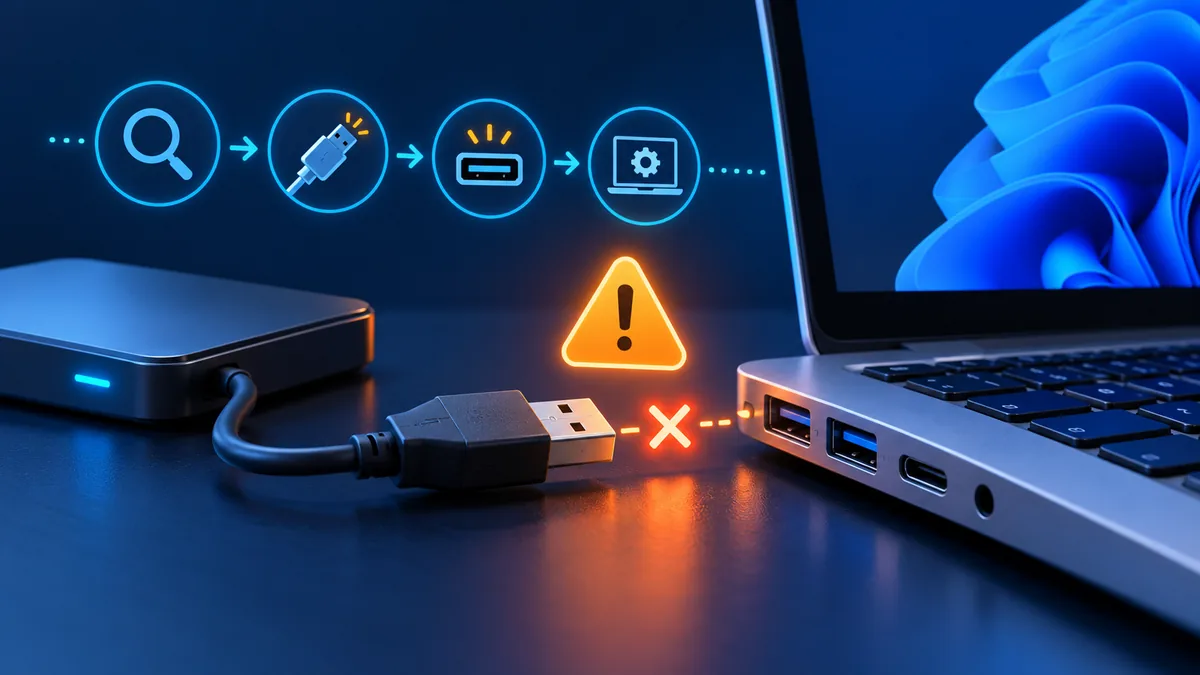
Table of Contents
Table of contents
What USB device not recognized Windows 11 means
The notification means USB enumeration failed or Windows could not load the device correctly. The cause can be a cable, connector, insufficient power, hub, driver, controller, device firmware or failed hardware. Storage devices add a separate data-recovery risk.
The guide applies to currently supported consumer versions. Managed devices, preview builds, unsupported hardware and organization-controlled accounts may require an administrator or vendor-specific process. Scope label: last USB device malfunctioned.
Symptoms and quick diagnosis
Confirm that you are solving the same problem before applying a fix. USB device not recognized Windows 11 can look similar to several unrelated failures, and the correct next step depends on what still works.
- Windows reports the last USB device malfunctioned.
- Device Manager shows Unknown USB Device.
- The device repeatedly connects and disconnects.
- It works in one port or on another computer only.
- A drive appears in Disk Management but not File Explorer.
Change one variable at a time. Compare service status, account state, the affected app, the operating system and the physical connection before using resets. Record the exact result after every test. Diagnostic label: last USB device malfunctioned.
Quick diagnostic checklist
- Stop if a drive clicks, overheats or contains irreplaceable data.
- Try one known-good cable and direct port.
- Remove unpowered hubs and docks.
- Restart Windows.
- Test the device on another trusted PC.
- Record Device Manager error codes.
Before changing anything
Save open work, keep account recovery details available, and create a current backup before changing drivers, system files or recovery settings. Do not download unofficial repair tools or drivers. Baseline: last USB device malfunctioned.
For last USB device malfunctioned, save work and record the exact message, time, version, and last successful action. Keep screenshots private. Do not share passwords, one-time codes, recovery keys, API keys, financial details, device serial numbers, or unredacted logs.
Use official downloads and support channels when investigating last USB device malfunctioned. If a step changes stored data, account access, drivers, firmware, network profiles, or recovery state, read its safety note first and keep a way back.
USB device not recognized Windows 11: step-by-step fixes
Work from the first last USB device malfunctioned check downward. The order deliberately starts with reversible checks and leaves resets, reinstallations, recovery operations, and hardware service until the evidence justifies them.
1. Protect data before troubleshooting storage
A disk with physical symptoms can worsen with repeated power cycles. Recognition problems do not justify formatting.
- Listen for clicking and check for unusual heat or smell.
- If data is irreplaceable, disconnect the drive and consult a recovery specialist.
- Do not initialize, format or run CHKDSK on an unstable unknown disk.
Expected result: The data-recovery risk is assessed before additional stress.
Safety or rollback note: Formatting and some repair tools can destroy recoverable metadata.
Test USB device not recognized Windows 11 again before continuing. A changed result identifies the layer that was responsible and prevents unnecessary later resets.
2. Reconnect through a known-good direct port
Hubs, front-panel ports and docks add power and signal points of failure.
- Shut down the device if its instructions require it.
- Connect directly to a different built-in USB port.
- Wait for enumeration and note whether the notification changes.
Expected result: A port-specific or hub-specific failure is identified.
Safety or rollback note: Do not force a connector; inspect for bent pins and debris.
Test USB device not recognized Windows 11 again before continuing. A changed result identifies the layer that was responsible and prevents unnecessary later resets.
3. Replace the cable with the correct data cable
Some USB cables provide power only, and damaged high-speed conductors can charge a device while data fails.
- Use a manufacturer-approved data-capable cable.
- Keep the cable short and avoid adapters for the test.
- Reconnect and check Device Manager.
Expected result: The device enumerates at its supported speed.
Safety or rollback note: A connector that becomes hot, loose or visibly damaged should be replaced.
Test USB device not recognized Windows 11 again before continuing. A changed result identifies the layer that was responsible and prevents unnecessary later resets.
4. Provide adequate power
Portable drives, phones and high-performance devices may exceed a port or unpowered hub’s capacity.
- Connect the laptop to AC power.
- Use the device power adapter or a reputable powered hub if specified.
- Disconnect other high-draw USB devices temporarily.
Expected result: Stable power prevents repeated disconnects.
Safety or rollback note: Use only correctly rated power supplies and hubs.
Test USB device not recognized Windows 11 again before continuing. A changed result identifies the layer that was responsible and prevents unnecessary later resets.
5. Restart Windows and power-cycle the device
A controller or device firmware state can clear after both sides restart.
- Disconnect the affected device.
- Restart Windows normally.
- Power-cycle the accessory according to its manual and reconnect once.
Expected result: USB enumeration completes after a clean controller start.
Safety or rollback note: Avoid repeated rapid connect-disconnect cycles.
Test USB device not recognized Windows 11 again before continuing. A changed result identifies the layer that was responsible and prevents unnecessary later resets.
6. Read the Device Manager error
The error code distinguishes descriptor failure, driver failure and device-start problems.
- Open Device Manager > Universal Serial Bus controllers.
- Open the Unknown USB Device or affected entry properties.
- Record the status and Hardware IDs before changing it.
Expected result: You have a specific error for targeted support.
Safety or rollback note: Do not remove every USB controller when keyboards or accessibility devices depend on them.
Test USB device not recognized Windows 11 again before continuing. A changed result identifies the layer that was responsible and prevents unnecessary later resets.
7. Update Windows, chipset and device drivers
USB controller behavior depends on Windows, chipset firmware and device drivers. Use official sources.
- Install stable Windows updates.
- Install chipset or USB drivers from the PC maker.
- Install the accessory maker’s current driver or utility if required, then restart.
Expected result: The controller and device load compatible drivers.
Safety or rollback note: Avoid generic driver updater programs.
Test USB device not recognized Windows 11 again before continuing. A changed result identifies the layer that was responsible and prevents unnecessary later resets.
8. Adjust USB power management only for a proven sleep issue
If the device works after boot but disappears after sleep, power management is relevant. Change the smallest documented setting and monitor battery impact.
- Open the relevant USB Root Hub properties.
- On Power Management, temporarily clear Allow the computer to turn off this device if available.
- Restart and reproduce the sleep test.
Expected result: The device remains present after sleep.
Safety or rollback note: This can increase battery use; restore the setting if it does not help.
Test USB device not recognized Windows 11 again before continuing. A changed result identifies the layer that was responsible and prevents unnecessary later resets.
9. Compare another computer and replace failed hardware
A device that fails with a known-good cable on multiple computers is likely defective. A device that works elsewhere points back to the first PC.
- Test on another supported trusted computer.
- Run the device maker’s diagnostics or firmware tool if it is recognized there.
- Use warranty or repair service when cross-device failure is confirmed.
Expected result: The failing side—PC or accessory—is isolated.
Safety or rollback note: Do not apply firmware if the connection is unstable or power may be interrupted.
Test USB device not recognized Windows 11 again before continuing. A changed result identifies the layer that was responsible and prevents unnecessary later resets.
Troubleshooting decision table
| What you observe | Most likely layer | Best next action |
|---|---|---|
| Works in another port | Port/hub | Use a healthy direct port and service the failed one. |
| Works with another cable | Cable | Replace with a rated data cable. |
| Fails on multiple PCs | Accessory hardware | Use warranty, repair or data recovery. |
| Drive in Disk Management only | Mount/file-system layer | Check letter and file system without formatting. |
| Fails only after sleep | Power management | Test documented power settings. |
Use the last USB device malfunctioned decision table to avoid repeating steps that cannot affect your symptom. If two rows appear to match, start with the one that requires the least invasive change.
When these fixes will not help
- The vendor reports a service incident that requires provider recovery.
- The device is controlled by an organization and the required setting is blocked by policy.
- Unsupported hardware or an obsolete operating-system build cannot use the feature.
- Physical damage requires qualified repair rather than another software reset.
Escalate after the reversible checks reproduce the same failure and the evidence points to an account, managed policy, firmware or hardware layer. Give support the exact message, version, timestamps and tests already completed. Case label: last USB device malfunctioned.
How to prevent the problem
- Install stable operating-system and application updates.
- Use official drivers, stores and support pages.
- Keep a current backup and recovery method.
- Avoid several major configuration changes at once.
- Record working settings before changing them.
Prevention for last USB device malfunctioned cannot eliminate provider outages or component failures, but it can preserve recovery options and make the next diagnosis much faster.
Frequently asked questions about USB device not recognized Windows 11
Why does my USB device charge but not appear?
The cable or port may provide power while the data connection is absent or damaged.
Should I uninstall Unknown USB Device?
Record its error first. Removing that single entry and rescanning can help, but mass-removing controllers is unnecessary.
Why is my USB drive in Disk Management but not File Explorer?
It may lack a drive letter or use an unsupported/damaged file system. Do not format it if data matters.
Can a powered USB hub fix recognition?
It can solve insufficient-power cases, but not bad cables, drivers or failed device hardware.
Official sources and related guides
The last USB device malfunctioned guidance in this article was checked against the following primary vendor resources. Interfaces and policies can change, so use the current vendor page when a label differs from your screen.
Continue with these related TrueFixGuides resources:
- Windows troubleshooting hub
- Windows Installer service could not be accessed
- This app cannot run on your PC
In summary, USB device not recognized Windows 11 should be handled by identifying the failing layer, applying the least destructive relevant fix, and confirming the result before moving on. Stop when the normal test succeeds; more changes do not make a working system more repaired.