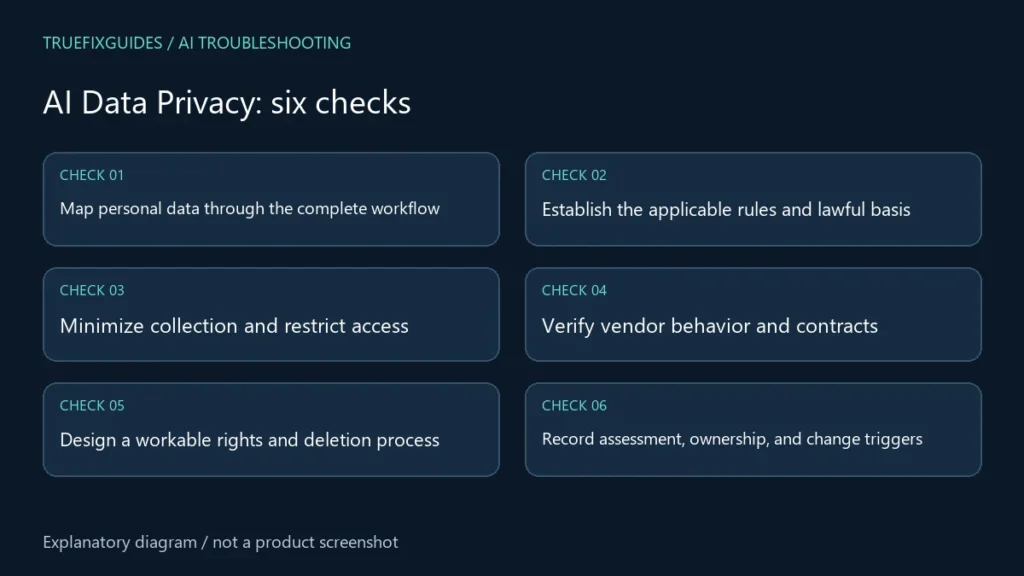
AI data privacy requires understanding what personal data enters a system, why it is used, where it goes, and how people can exercise applicable rights. A security setting or consent banner cannot answer all of those questions. Use this checklist to prepare a documented review with your privacy lead, rather than treating it as a certificate of legal compliance.
Table of Contents
1. Map personal data through the complete workflow
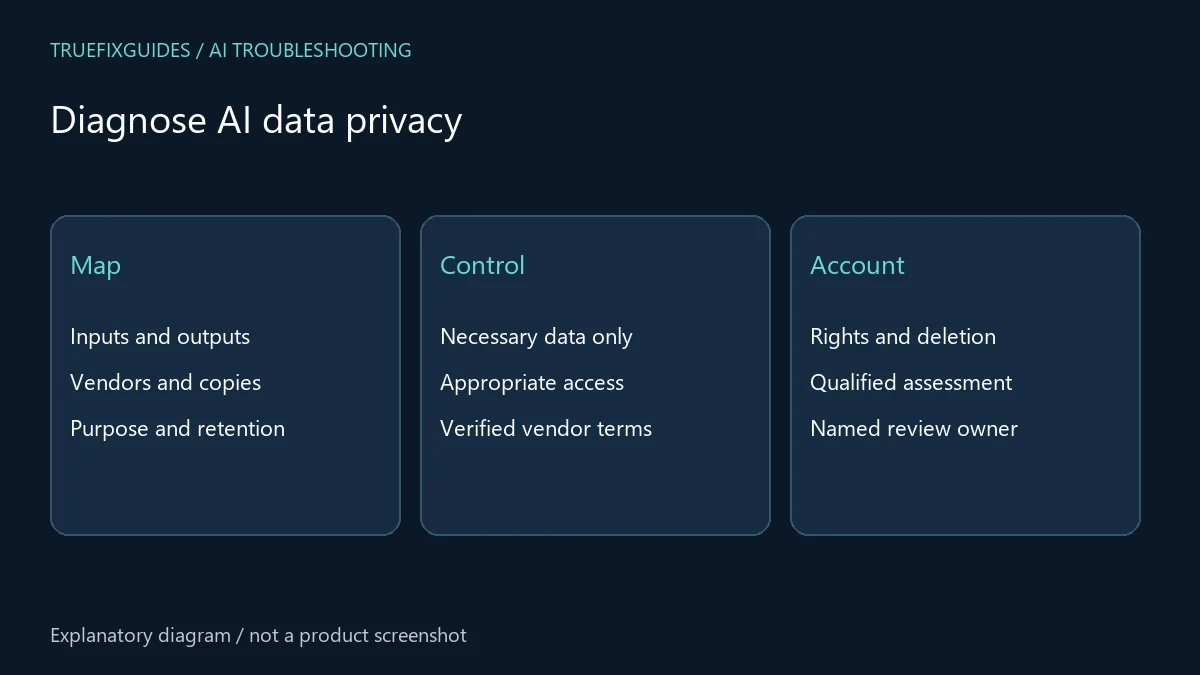
Inventory inputs, uploaded files, prompts, training datasets, retrieval indexes, outputs, logs, and backups. Record the people the data relates to, its source, purpose, storage location, recipients, and retention arrangements. Include diagnostic tools and contractors that may receive copies.
For AI data privacy, distinguish development from production and note whether data is used to train a model, answer a request, or monitor service quality. These are different processing activities. Use a small representative workflow to check the map against what the system actually sends and stores, with private values redacted.
2. Establish the applicable rules and lawful basis
Identify the jurisdictions, organizational roles, and data categories involved with qualified privacy advice. Do not assume consent is always the appropriate basis or that installing a consent-management platform authorizes every use of personal data.
The UK ICO’s lawfulness guidance discusses this assessment for AI. It is UK-specific and currently marked for review following legislative changes. Document the applicable requirements for your situation and check current guidance. AI data privacy obligations cannot be inferred solely from a model vendor’s marketing claims.
3. Minimize collection and restrict access
Ask whether each field is necessary for the documented purpose. Remove unnecessary personal details before transmission where feasible. Limit access to datasets, prompts, outputs, and logs according to job needs, and review how long each copy is retained.
The ICO’s security and minimization guidance provides a relevant reference for UK reviews. Test controls with realistic workflows. AI data privacy work should cover an engineer’s debugging export and a support ticket attachment, not only the main application database.
4. Verify vendor behavior and contracts
Review the actual product, account settings, contract, subprocessors, retention options, and data-use terms. A provider may offer different arrangements across products or plans. Record which terms apply to your deployment and who approved them.
Check what happens to submitted data, whether it is used for model improvement, where processing occurs, and how deletion requests are handled. Do not assume a general privacy statement answers every operational question. For AI data privacy reviews, keep dated evidence and assign an owner to reassess changes in vendor features, contracts, or data flows.
5. Design a workable rights and deletion process
Identify how a request is received, verified, routed, fulfilled, and documented under the applicable rules. Trace data across source systems, indexes, logs, exports, and backups. Determine which copies can be removed directly and which require a more complex assessment.
The ICO’s individual-rights guidance discusses challenges in AI systems. Do not promise that deleting a source row automatically removes its influence from trained model weights. AI data privacy procedures need technically accurate descriptions of the action taken and any lawful limitations.
6. Record assessment, ownership, and change triggers
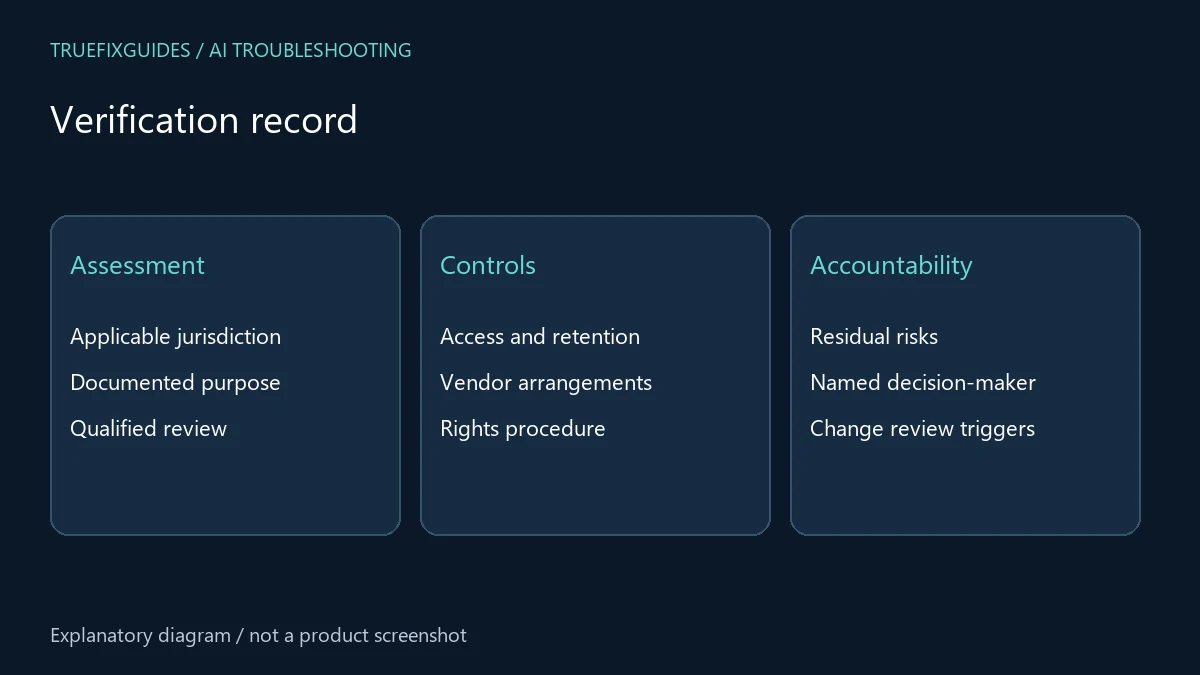
Have the privacy lead determine whether an impact assessment or other formal review is required, and complete it at the appropriate stage. Record risks, controls, residual concerns, decisions, and the people accountable for them. Keep fairness and security assessments connected without treating them as substitutes for privacy review.
Revisit the assessment when the purpose, data source, model, vendor, or deployment changes. Our AI tools collection covers related technical issues. Track AI data privacy work with evidence and named owners instead of relying on an arbitrary annual checkbox.
7. Test AI data privacy controls with a realistic scenario
Choose one representative request and trace it from collection to deletion. Use invented or safely anonymized values, not a real customer record. Confirm what reaches the model provider, application logs, analytics service, support tools, retrieval index and backups. Compare that observed route with the approved data map.
| Control question | Evidence to retain |
|---|---|
| Was every field necessary? | Approved input schema and minimization decision |
| Who could access the request? | Role and access review |
| Did a vendor retain or reuse it? | Applicable product terms and account setting |
| Can the record be found and deleted? | Completed test across indexes, logs and exports |
| Would an incident be detected? | Alert, escalation owner and response record |
For AI data privacy, a policy is incomplete until the operating system can produce evidence. Record failed checks as open risks with an owner and deadline. Do not copy sensitive production data into a test merely to make the scenario realistic.
Prepare for an AI privacy incident
Define how staff report accidental prompt disclosure, excessive logging, an unauthorized export or a vendor incident. Preserve relevant evidence, limit further exposure and involve the privacy and security owners. Applicable notification duties and timelines require qualified advice; do not publish personal details while investigating.
Use the NIST AI Risk Management Framework as a risk-management reference and the regulator guidance applicable to your jurisdiction. NIST guidance is voluntary and does not replace privacy law or a formal impact assessment.
Verification checklist
Before approving a workflow, confirm the data map, documented purpose, applicable legal assessment, access controls, retention, vendor terms, and rights process. Keep unresolved AI data privacy risks visible to decision-makers. Record what was tested, what remains uncertain, and what future changes require a new review.
Frequently asked questions
Does pseudonymizing data make it anonymous?
Not automatically. Replacing direct identifiers can reduce exposure while the information remains personal data if people can still be identified. Have the privacy team assess identifiability in the actual context.
Does this checklist guarantee GDPR or other legal compliance?
No. Applicable obligations depend on jurisdiction, processing, data, and organizational roles. This is an operational review aid. Qualified advice and current regulator guidance are needed for legal conclusions.
Editorial note: Revised with AI assistance using the linked primary sources, reviewed October 24, 2026. Diagrams explain the workflow; no hands-on testing of a specific system is claimed.