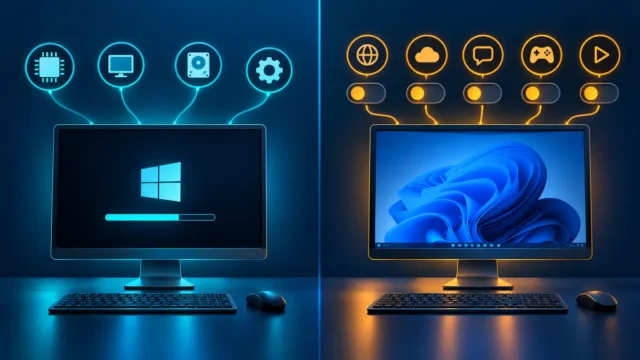
System Restore vs Reset This PC is a data-safety decision. System Restore reverses system changes from a restore point while preserving personal files; Reset This PC reinstalls Windows, removes apps and settings, and asks whether to keep or remove personal files. Check your backup and BitLocker recovery key before either operation.

Table of contents
System Restore vs Reset This PC: quick answer
System Restore vs Reset This PC: choose System Restore when a suitable restore point predates a recent driver, app, update or settings problem. It rolls back system changes while leaving personal files in place. Choose Reset This PC when Windows needs a broader reinstall and less disruptive recovery has failed. Reset can keep personal files or remove everything, but Microsoft says apps and settings are removed. Back up before either choice.
Neither option repairs a failing drive or replaces a verified backup. On some current Windows 11 versions, Microsoft also offers Point-in-time restore and a Windows Update reinstallation that may be a better fit. Do not mistake Point-in-time restore for the older System Restore: the newer feature can roll personal files back to a recent snapshot.
| Effect | System Restore | Reset This PC |
|---|---|---|
| Main action | Rolls system files and settings back to a restore point | Reinstalls Windows |
| Personal files | Kept by design | Keep my files or Remove everything |
| Installed apps | Apps changed since the point may be affected | Apps are removed |
| Settings | Recent system changes are reversed | Settings are removed or reset |
| Prerequisite | A suitable restore point | Working recovery environment and a backup plan |
How this comparison was checked
This guide compares documented recovery effects and steps from Microsoft’s current Windows Support pages. It does not claim that recovery was run on a particular PC or that a procedure will restore every application. The main decision is based on the change you need to undo, what the tool preserves, and what the reader can recover if Windows fails to start.
Microsoft changes recovery options by Windows version, edition and device configuration. A current Windows 11 PC may show Point-in-time restore or Reinstall Windows using Windows Update; an older PC may not. Check the choices actually displayed on your machine and the confirmation screen before committing. This article describes the common System Restore and Reset This PC paths and calls out newer alternatives where they change the decision.
What System Restore changes and preserves
System Restore applies a previously saved restore point. Microsoft says it rolls system files, registry settings and installed programs back to their earlier state without affecting personal files. That makes it useful when a recent software installation, driver update or configuration change plausibly caused the problem. It is not a personal-file backup or version history.
Applications and drivers installed after the selected point may need to be reinstalled, while something removed after that point may reappear. Before confirming, use Scan for affected programs to understand the likely changes. An appropriate restore point must exist, and the point should be from before the symptom began. A point created after the failure cannot undo its cause.
Microsoft documents System Restore from a signed-in Windows session and from the Windows Recovery Environment. If the PC is encrypted, the recovery environment may require the BitLocker recovery key. System Restore can fail or leave the original symptom unchanged; record the result and avoid repeating the same point without new evidence.
What Reset This PC changes and preserves
Reset This PC reinstalls Windows. Microsoft says you can choose to keep or remove personal files, but apps and settings are removed. Keep my files is not a promise that every folder, profile, application database or unsynced item will survive a failed reset; make an independent backup first. Remove everything is deliberately more destructive and is inappropriate when the only copy of important data remains on the PC.
The reset flow may offer local reinstall or cloud download. Those describe where Windows installation files come from, not the Keep my files decision. Read both selections on the confirmation screen. Do not confuse Reset This PC’s cloud download with Microsoft’s newer Cloud rebuild recovery option, which the current recovery guidance describes separately and says removes personal files, apps and settings.
Plan to reinstall your desktop programs, sign back into accounts and restore settings afterward. Keep installers and license details available. Work and school devices may use custom provisioning, encryption or administrator policy; ask IT before resetting them. If the PC has a failing SSD, a reinstall can put additional load on it without repairing the hardware.
Choose by symptom and what you can afford to lose
| Situation | Better first path | Reason |
|---|---|---|
| Failure began just after a driver or app installation | System Restore if a suitable point exists | Targets the recent system change |
| One Windows update caused trouble | Check uninstall-update option first | More targeted than a full reset |
| Windows files are damaged but desktop works | Try documented repair tools or supported reinstall first | May preserve apps and settings |
| Many Windows components still fail after focused repair | Consider Reset This PC with a backup | Reinstalls Windows more broadly |
| Drive errors or clicking hardware | Back up and diagnose hardware | Neither recovery tool repairs the drive |
| Personal files are missing | Use file backup or recovery path | System Restore is not file history |
Microsoft’s current guidance places Reset This PC after less disruptive options. On supported Windows 11 versions, reinstalling the current Windows version via Windows Update can preserve files, apps and settings. Point-in-time restore may be available for a recent failure, but it can roll back personal files too. Those effects are different enough that you must not substitute one option for another based only on the word “restore.”
Prepare a backup and BitLocker key first
Copy irreplaceable files to a separate location and check that the copy opens. Include project folders, browser exports, photos, mail archives, game saves and application data that may not sync automatically. A cloud-sync icon alone is not proof that the newest version has uploaded. If Windows is unstable, prioritize data you cannot recreate before attempting a long recovery operation.
Find your BitLocker recovery key before entering Windows Recovery Environment. Microsoft says it is required for many recovery options on an encrypted device. Keep it in a secure location you can reach without the affected PC. Do not post the key in a forum or send it to an untrusted repair utility. If the device belongs to an organization, the administrator may hold the key and control recovery.
Record your Windows edition, account sign-in method, network credentials, app licenses and current symptom. Keep the PC on stable power. If you intend to reset, make sure you can reinstall the apps you need afterward. A recovery operation is a poor time to discover that an essential installer or license is unavailable.
Use System Restore when a suitable point exists
- Open Control Panel > Recovery > Open System Restore, or press Windows+R, enter
rstrui.exe, and press Enter. Microsoft documents both entry points. - Select Next and choose a restore point dated before the problem. Use Show more restore points if the expected point is not visible.
- Select Scan for affected programs and review the likely app and driver changes. If the list contains something essential that you cannot reinstall, pause and prepare a recovery path.
- Confirm the correct restore point and choose Finish. Allow Windows to restart and complete the operation.
- After sign-in, repeat the original failing task. Reinstall affected software only when needed and check Windows Update for current security fixes.
If Windows will not start, Microsoft’s recovery environment offers Troubleshoot > Advanced options > System Restore. The exact entry method depends on the device and failure. Have the BitLocker key available before you enter recovery. If the restore fails, note the exact message; trying a different point may be reasonable, but do not assume repeated restores will fix a physical disk fault.
Use Reset This PC only after checking its effects
- Verify an independent backup and write down the apps and settings you will need afterward.
- Open Settings > System > Recovery and locate Reset this PC, or use Troubleshoot > Reset this PC in Windows Recovery Environment if the PC cannot start.
- Choose Keep my files or Remove everything based on the actual data-preservation decision. Read the displayed summary carefully. Do not choose Remove everything if important data remains only on the device.
- If offered, choose the supported reinstall source that fits your connection and repair needs. Cloud download and local reinstall do not replace the file-preservation selection.
- Keep stable power, allow the process to finish, then set up Windows, reinstall apps, restore data from your backup and test the original symptom.
Microsoft describes Reset This PC as a more disruptive option than targeted repair. If a confirmation screen differs from the expected effects, stop and consult current Microsoft or device-maker guidance before proceeding. Do not force shutdown during a recovery phase merely because progress seems slow.
Where newer Windows recovery options fit
Point-in-time restore is a newer Windows 11 feature available on supported versions. Microsoft says it restores the operating system, apps, settings and personal files to a recent automatic snapshot, unlike System Restore, which leaves personal files alone. Changes made after that snapshot can be lost. Check what it will roll back before selecting it, especially if you created important local files recently.
Reinstall Windows using Windows Update is described by Microsoft as a less disruptive reinstallation on supported Windows 11 versions that keeps files, apps and settings. If the problem calls for Windows repair rather than reverting a known recent change, check whether this option is available before resetting. Uninstall updates can be more targeted when one update started the problem.
The choices shown in Windows Recovery Environment vary by version and device. A branded manufacturer recovery may have different data effects from Microsoft’s Reset This PC. Verify the exact option name and confirmation text rather than assuming every “restore” or “rebuild” choice has the same outcome.
When neither option will help
Neither System Restore nor Reset This PC repairs a defective drive, failing memory, broken power supply or damaged external accessory. If corruption returns immediately, back up and run appropriate hardware diagnostics. A website login problem, one browser extension or an account-side outage also will not normally be solved by reinstalling Windows.
If the PC is managed, locked by policy or encrypted and you cannot access its recovery key, involve the administrator. If malware is suspected, follow Microsoft’s security and recovery instructions rather than assuming a restore point removes every infection. If the only copy of personal data is at risk, seek data-recovery advice before a reset or reinstall writes more to the drive.
Frequently asked questions
Does System Restore delete personal files?
Microsoft says System Restore changes system files and settings without affecting personal files. It can change recently installed apps, drivers and updates. It is still wise to maintain a separate backup.
Does Keep my files keep installed apps?
No. Microsoft says Reset This PC removes apps and settings even when you choose to keep personal files. Keep installers, license information and an independent file backup.
Can I use System Restore if Windows will not start?
Yes, Microsoft documents it in Windows Recovery Environment under Troubleshoot > Advanced options > System Restore. An encrypted device may require its BitLocker recovery key.
Is Point-in-time restore the same as System Restore?
No. Microsoft’s newer Point-in-time restore can roll back personal files along with apps and settings to a recent snapshot. Traditional System Restore leaves personal files in place.
Should I reset after one bad Windows update?
Check the targeted uninstall-update option, a suitable restore point or other less disruptive recovery first. Reset This PC reinstalls Windows and requires more setup afterward.
Will Reset This PC fix a failing SSD?
No. Reinstalling Windows does not repair physical storage. Back up important data and investigate the drive before repeating recovery operations.
Official sources and related guides
Microsoft’s current recovery documentation describes the preservation and removal effects used in this guide. Menus and feature availability vary by Windows version and device.
- Microsoft: Recovery options in Windows
- Microsoft: System Restore steps
- Microsoft: Point-in-time restore differences
For related symptoms, see the Windows troubleshooting hub, black screen after login guide, and Windows Update stuck guide.
Conclusion
For System Restore vs Reset This PC, use the smallest recovery action that matches the evidence. A restore point can reverse a recent system change without removing personal files. Reset This PC reinstalls Windows and removes apps and settings, with a separate choice about personal files. Back up first, find your BitLocker key, and read the exact confirmation screen before proceeding.