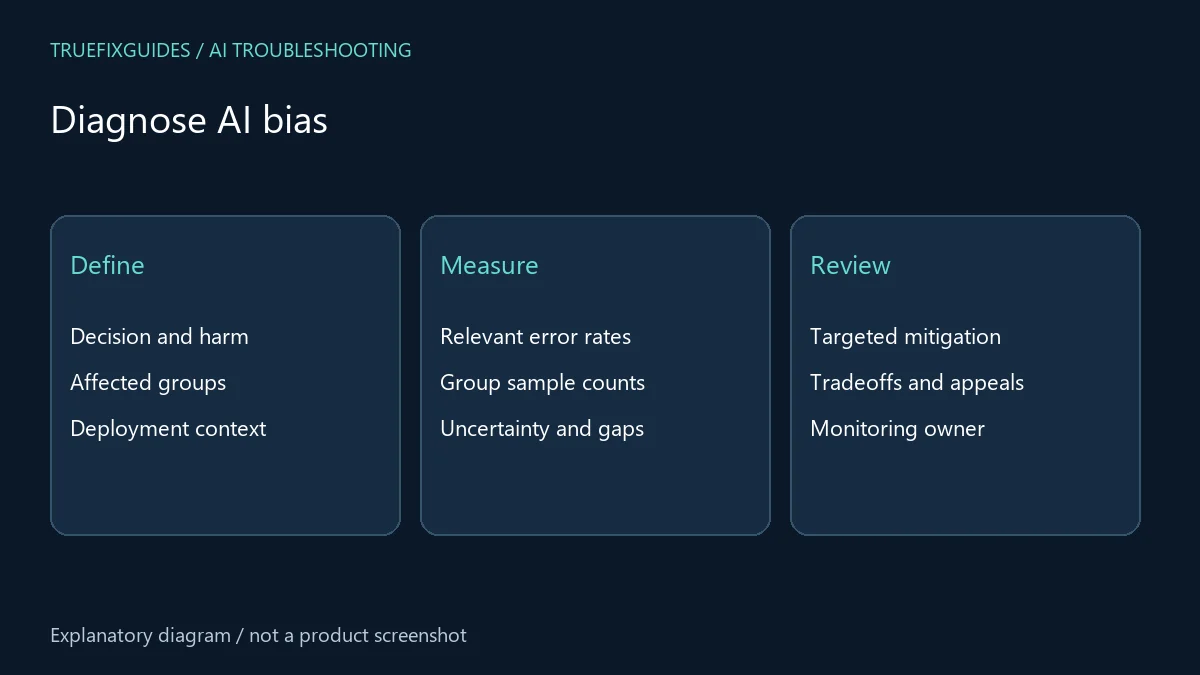
AI bias can appear when a prediction system produces harmful differences in outcomes or service quality across groups. A high overall accuracy score can hide these differences. The goal is to identify the relevant harms, measure them with appropriate evidence, and evaluate changes in the context where the system will be used. Start with a specific decision, the people affected and the error that could cause harm.
1. Define the harm before measuring AI bias
Start with a concrete decision and the people affected. For a transcription system, the question might be whether speakers of a particular dialect receive substantially more errors. For a recommendation system, it might concern which creators are repeatedly excluded. Write down the outcome you want to assess and why it matters.
Fairlearn’s assessment guide begins with harms and affected groups. Use that framing to choose an assessment, rather than declaring a system fair because it passes a convenient metric. Include people who understand the deployment setting in this discussion.
The same numerical difference can mean different things in different products. A speech transcription error may prevent a person from using a service; a recommendation error may reduce the exposure of certain creators. Define the affected population, how the prediction enters a decision, and the consequence of a false positive or false negative. Record why each group and metric was chosen before looking at the results.
For AI bias in a consequential workflow, inspect the human process too. Which decisions are automatic? Can someone contest an outcome? Is there a usable alternative when the model is uncertain? The NIST AI Risk Management Framework treats risks as part of the system and its context, not only a model score. This guide is a technical starting point; specialized review is needed where decisions affect rights, safety or access to essential services.
2. Examine labels and data coverage
Inspect how examples were collected, which people or conditions are missing, and who assigned the labels. A historical decision is not automatically a reliable label for the outcome you actually want. Preserve disagreements instead of silently turning uncertain cases into confident answers.
For AI bias analysis, record sample counts alongside group definitions. Very small groups may produce unstable estimates. Do not infer sensitive characteristics from names or photographs merely to fill an audit spreadsheet. Determine whether the required group information can be collected and used appropriately, with privacy and domain specialists where necessary.
Sample examples from each relevant source, time period and group. Check whether a label represents an observed outcome or a past human decision that could have its own bias. A “successful application” label, for example, may reflect who was previously selected rather than who could succeed. Do not assume that adding more of the same historical records fixes the underlying measurement problem.
AI bias can be amplified by missing values, inconsistent label rules and uneven collection. The Google fairness lesson recommends examining missing features, unusual values and subgroup coverage. Use the AI dataset quality guide to document source defects before changing the model. Preserve small-group counts and privacy constraints when reporting results.
3. Compare relevant metrics and uncertainty
Measure the errors that correspond to the stated harm. Report group-level results alongside the overall result, counts, and uncertainty. Examine relevant intersections when the data supports them. A single average may conceal an important failure.
Fairlearn’s metric documentation explains different fairness criteria. They answer different questions and need not agree. For example, equal selection rates and equal error rates are not interchangeable goals. Choose metrics before comparing candidate fixes so an AI bias review does not become a search for whichever chart looks most favorable.
Choose a metric that corresponds to the harm. If the concern is missed cases, compare false-negative behavior; if unnecessary intervention is costly, inspect false positives too. Show the denominator and sample count for every group so a percentage is not mistaken for strong evidence. Where data is limited, describe uncertainty and avoid declaring a disparity absent because a test lacked power.
AI bias analysis should compare the same data window and decision threshold across groups. If thresholds differ, explain why and evaluate the downstream effects. Examine intersections only where sample size and privacy rules support a meaningful report. Overall accuracy can improve while a small group becomes worse, so include both aggregate and subgroup results in the decision record.
4. Test a targeted change against a baseline
Choose a change that addresses the observed failure: clarify labeling instructions, improve coverage of an underrepresented condition, revise a feature, or evaluate an appropriate mitigation method. Keep the original system and assessment protocol as the comparison baseline.
Assess both the intended improvement and potential costs elsewhere. A change can reduce one disparity while worsening another error or increasing uncertainty. Record those tradeoffs in plain language. Do not promise that removing one demographic column eliminates AI bias; other variables and the surrounding decision process can still encode related patterns.
Run a targeted experiment rather than a collection of untracked changes. If underrepresentation is the suspected cause, improve the relevant collection or labeling process and evaluate on a fixed, representative holdout. If the model’s feature or threshold is the cause, compare the change with the previous version on each important metric. Keep an explanation of tradeoffs and cases that remain unresolved.
For AI bias mitigation, check whether a reported gain survives a later time period and whether it changes false positives or false negatives elsewhere. Fairness definitions can conflict, so one technique cannot guarantee every objective at once. The Google mitigation lesson describes data-level and model-level approaches; select a method only after identifying the specific failure.
5. Review deployment decisions and appeals
Decide what happens when the system is uncertain, when performance is inadequate for a particular setting, or when someone challenges an outcome. A human reviewer needs useful information, authority to act, and a way to record the reason for a correction.
Test the complete workflow with realistic cases. Adding a person at the end of a process is not enough if that person cannot question the model. For AI bias in consequential decisions, involve qualified domain and legal reviewers before deployment. A technical metric alone cannot establish that the use is appropriate or lawful.
Write an escalation rule: what evidence sends a case to a reviewer, what the reviewer may change, and how their decision is recorded. Test whether the reviewer has enough context to disagree with the model. A nominal “human in the loop” step adds little if the person sees only a score and is expected to approve it automatically.
AI bias findings may require limiting the use of a feature, changing the workflow or pausing an automated decision while evidence is gathered. The appropriate response depends on the potential harm. Document who can authorize a rollback or pause and how affected users can reach the review path. Do not present a small technical disparity improvement as proof that the overall process is fair.

6. Monitor outcomes after deployment
Keep an assessment record with model version, data period, group definitions, metrics, limitations, and decisions. Set a review schedule based on the system’s impact and rate of change. Trigger additional review after important changes in data, users, labels, or the decision workflow.
Monitor complaints and real outcomes as well as model scores. Assign an owner to investigate regressions and define when use should be limited or paused. Our model drift guide helps distinguish changing deployment data from a one-time training problem. Track AI bias findings as ongoing engineering and governance work.
Set monitoring that can detect changes in data coverage, errors and real-world outcomes, not just average prediction confidence. Review by relevant group when permitted and meaningful. If a new source or policy changes the population, repeat the assessment rather than assuming the old result applies. Complaints and appeal outcomes can reveal problems that an offline test set missed.
For AI bias incidents, keep a versioned record of the model, dataset, threshold, evaluation window, group definitions, reviewer and action. Set a trigger for investigation when a meaningful metric or complaint pattern changes. The trigger should reflect the system’s impact and uncertainty, not a universal percentage copied from another project.
AI bias: diagnostic decision table
| Signal | Evidence to gather | Next review |
|---|---|---|
| Overall score is good, one group reports failures | Group-specific error types, counts and examples | Check whether the error reflects the defined harm |
| One group has many missing features | Collection source and missingness by period | Investigate data coverage before retraining |
| Two fairness metrics disagree | Each metric’s definition and affected decision | Choose objectives with context experts |
| A mitigation improves one measure but worsens another | Fixed holdout and subgroup tradeoffs | Document or reject the change |
| Problems appear after a release | Model, data, threshold and workflow versions | Pause or roll back when impact warrants it |
The table helps organize an AI bias investigation. It cannot determine fairness from one metric or replace input from people affected by the system.
Verification checklist
Before closing the assessment, confirm that the harm is defined, relevant groups have adequate evidence, metrics reflect the use case, and tradeoffs are documented. Keep unresolved questions separate from completed tests. A useful AI bias report explains what changed, what did not improve, and who owns the next review. Keep the AI bias assessment connected to the deployment decision.
Frequently asked questions
Can one metric prove a model is unbiased?
No. Metrics quantify selected aspects of performance under chosen definitions. They cannot capture every harm or resolve whether a decision process is appropriate. Keep the scope and limitations of each assessment visible.
Can removing a sensitive attribute remove bias?
No guarantee follows from deleting one column. Other features may act as proxies, and the data or decision process may still contain harmful patterns. Assess outcomes and errors under the actual workflow.
What if a group has too few examples to estimate an error rate?
Report the limitation. Avoid confident claims based on unstable estimates, protect privacy and plan appropriate data collection or expert review before making a consequential decision.
Does collecting more data always solve the problem?
No. More examples with the same coverage gaps or unreliable labels may repeat the problem. Improve the specific weakness and evaluate the resulting change against a fixed baseline.
Editorial note: Revised with AI assistance using the linked primary sources, reviewed November 23, 2026 against NIST, Google and Fairlearn guidance. Diagrams explain the workflow; no hands-on testing of a specific system is claimed.