eSIM vs physical SIM is not a single-winner contest. Choose eSIM for fast digital activation, travel plans, and multiple lines when the carrier and phone support it. Choose a physical SIM when frequent manual swapping, broad older-device compatibility, or recovery without carrier reactivation matters. The correct decision depends on the device, workload, compatibility requirements, privacy expectations, recovery options, and what must keep working after the change.
This eSIM vs physical SIM guide gives a direct answer first, then compares the choices across practical criteria. It is written for readers who need to choose, troubleshoot, or migrate safely. It does not invent laboratory scores or claim hands-on testing that was not performed.
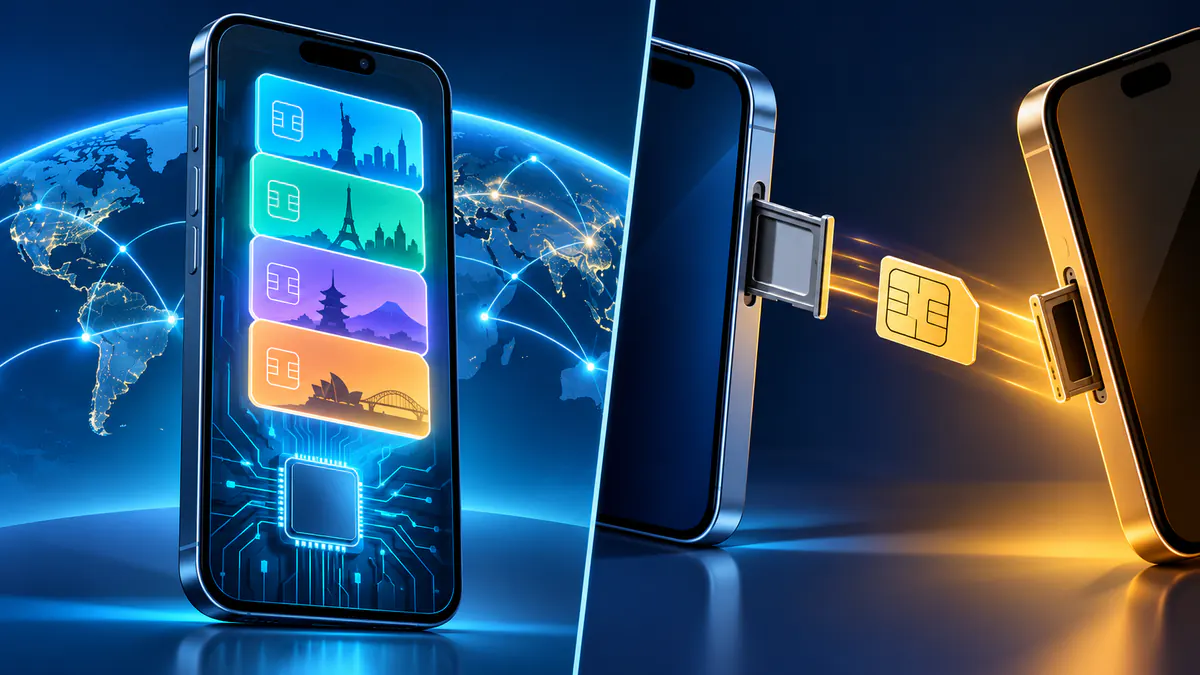
Table of contents
eSIM vs physical SIM: quick verdict
Choose eSIM for fast digital activation, travel plans, and multiple lines when the carrier and phone support it. Choose a physical SIM when frequent manual swapping, broad older-device compatibility, or recovery without carrier reactivation matters.
| Choose eSIM | Choose a physical SIM |
|---|---|
| you use travel data plans | you regularly move service between phones |
| your phone supports multiple eSIM profiles | your carrier has limited eSIM support |
| you prefer digital carrier activation and no removable card | you value recovery by inserting the card into a spare compatible device |
If the eSIM vs physical SIM recommendation still feels close, rank the criteria that can block the task: compatibility first, then data safety and recovery, then required features, reliability, support, and total cost. Cosmetic preferences should break a tie, not override a hard requirement.
How this comparison was made
The eSIM vs physical SIM assessment uses documentation-based feature, compatibility, safety, privacy, recovery, and workflow comparison; no sponsored placement and no claim of hands-on benchmark testing. Claims are limited to behavior documented by the vendors or standards bodies linked below, plus conservative troubleshooting principles that preserve data and settings.
This eSIM vs physical SIM article is not a paid placement, and no winner was selected for affiliate value. Prices, plan limits, model names, firmware, operating-system menus, and supported features can change. Check the current official page before purchasing hardware, changing a subscription, or using a destructive recovery option.
A fair eSIM vs physical SIM trial holds variables constant. Use the same input, file set, network, accessory, task length, and success test. Measure whether the task finishes correctly, how much correction it needs, what breaks, how recovery works, and whether the result can be repeated.
What eSIM and a physical SIM actually do
eSIM is one side of the decision because it emphasizes: embedded and provisioned digitally. It should be evaluated in the context of you use travel data plans; your phone supports multiple eSIM profiles; you prefer digital carrier activation and no removable card. Its advantage disappears if the required device, account, driver, file system, protocol, or recovery path is unsupported.
a physical SIM emphasizes: removable card placed in a sim tray. It is the stronger candidate when you regularly move service between phones; your carrier has limited eSIM support; you value recovery by inserting the card into a spare compatible device. Confirm the exact product version and configuration, since a familiar name does not guarantee identical capability on every platform.
Side-by-side comparison
| Criterion | eSIM | a physical SIM | Practical edge |
|---|---|---|---|
| Form | Embedded and provisioned digitally | Removable card placed in a SIM tray | Different design |
| Activation | Carrier QR code, app, transfer, or activation flow | Insert an activated card or obtain one from the carrier | eSIM can be faster |
| Device switching | May require supported transfer or carrier reactivation | Can often be moved directly between compatible unlocked phones | Physical SIM |
| Travel | Multiple stored plans can simplify travel | Local cards are easy to buy in many places | Depends on destination |
| Loss or theft | Cannot be physically removed from the tray | Can be removed, though carrier protections still matter | eSIM |
| Damaged phone | Moving service may require account access or carrier help | The card can often move to a working phone | Physical SIM |
| Capacity | Phones can store multiple profiles, with active-line limits by model | Limited by physical slots | eSIM |
| Compatibility | Requires eSIM support from phone and carrier | Works across a wider legacy device base | Physical SIM |
| Repair | No tray or card contact issue | Card and tray can be inspected or replaced separately | Different failures |
1. Form
eSIM: Embedded and provisioned digitally. a physical SIM: Removable card placed in a SIM tray. Practical edge: Different design. This distinction matters when a decision must survive normal day-to-day use, not just a one-minute setup test. Record the observed comparison result rather than assuming every version behaves alike.
2. Activation
eSIM: Carrier QR code, app, transfer, or activation flow. a physical SIM: Insert an activated card or obtain one from the carrier. Practical edge: eSIM can be faster. Treat this as a workflow requirement rather than a marketing checkbox, because configuration can change the practical result. Record the observed comparison result rather than assuming every version behaves alike.
3. Device switching
eSIM: May require supported transfer or carrier reactivation. a physical SIM: Can often be moved directly between compatible unlocked phones. Practical edge: Physical SIM. Use the same device, connection, workload, and success criteria when testing this point so the comparison remains fair. Record the observed comparison result rather than assuming every version behaves alike.
4. Travel
eSIM: Multiple stored plans can simplify travel. a physical SIM: Local cards are easy to buy in many places. Practical edge: Depends on destination. The right choice depends on the failure you are preventing and the recovery path you can actually support. Record the observed comparison result rather than assuming every version behaves alike.
5. Loss or theft
eSIM: Cannot be physically removed from the tray. a physical SIM: Can be removed, though carrier protections still matter. Practical edge: eSIM. Document this requirement before paying, formatting, resetting, or moving important data; it is expensive to discover it later. Record the observed comparison result rather than assuming every version behaves alike.
6. Damaged phone
eSIM: Moving service may require account access or carrier help. a physical SIM: The card can often move to a working phone. Practical edge: Physical SIM. A product or feature update can change this detail, so verify the linked official documentation at the time of setup. Record the observed comparison result rather than assuming every version behaves alike.
7. Capacity
eSIM: Phones can store multiple profiles, with active-line limits by model. a physical SIM: Limited by physical slots. Practical edge: eSIM. For managed equipment, an administrator policy can override the consumer behavior described here. Record the observed comparison result rather than assuming every version behaves alike.
8. Compatibility
eSIM: Requires eSIM support from phone and carrier. a physical SIM: Works across a wider legacy device base. Practical edge: Physical SIM. If both options meet the requirement, let the next criterion decide instead of over-weighting a theoretical advantage. Record the observed comparison result rather than assuming every version behaves alike.
9. Repair
eSIM: No tray or card contact issue. a physical SIM: Card and tray can be inspected or replaced separately. Practical edge: Different failures. A controlled trial is more reliable than specifications alone when accessories, drivers, accounts, or network conditions are involved. Record the observed comparison result rather than assuming every version behaves alike.
Choose eSIM when
- You use travel data plans. This is the strongest signal because it describes the main workflow rather than a rare edge case.
- Your phone supports multiple eSIM profiles. Confirm this requirement with the actual device, account, or application before committing.
- You prefer digital carrier activation and no removable card. Keep the alternative available until the first complete real-world task succeeds.
Choose a physical SIM when
- You regularly move service between phones. This use case gives the option a meaningful operational advantage.
- Your carrier has limited eSIM support. Test the feature with current software and normal security controls enabled.
- You value recovery by inserting the card into a spare compatible device. Plan how data, settings, and credentials will move if the choice later changes.
a physical SIM deserves the same evidence standard. Verify the complete workflow rather than a demonstration, including authentication, import or transfer, output quality, reconnection after restart, and recovery after one deliberate failure test.
Safe evaluation and switching plan
Before changing anything in the eSIM vs physical SIM decision, make a recoverable baseline. Save configuration, export data where supported, record versions, keep recovery credentials, and photograph physical cable or port layouts when relevant.
- Step 1: Confirm that the phone is unlocked and supports the target SIM type. Write the baseline down so memory is not the only record.
- Step 2: Ask the carrier about activation, transfer, and replacement procedures. Do not remove the current working option yet.
- Step 3: Keep the old line active until calls, SMS, and data work on the new setup. Use non-sensitive sample data for the first trial.
- Step 4: Test two-factor SMS and emergency calling where permitted. Compare the result with the original acceptance criteria.
- Step 5: Remove the old profile or card only after the new service is stable. Keep the rollback materials until several normal tasks succeed.
Safety warning: Before erasing, selling, or repairing a phone, confirm whether the eSIM will be retained, transferred, or removed. Save carrier login and recovery information, and never publish an activation QR code. Stop if the test threatens the only copy of data, requires an unknown command, removes account recovery, weakens network security, or selects a disk or device you cannot positively identify.
Troubleshooting the choice
If eSIM works but a physical SIM does not, compare prerequisites before assuming a defect. Check version, account entitlement, operating-system support, firmware or driver level, available memory or storage, network policy, permissions, and the exact input used.
If neither eSIM vs physical SIM side works, return to a known-good baseline. Test a second cable, device, account, network, file, or small workload where relevant. The shared failure often sits outside the comparison—for example, a damaged source file, expired credential, blocked port, failing storage device, or service outage.
If both work but results vary, repeat the same task at least three times and note latency, errors, reconnections, manual corrections, power or resource use, and recovery. For eSIM vs physical SIM, stability across ordinary use is more valuable than one unusually fast run.
When neither option is right
Do not force the eSIM vs physical SIM choice when a third path better matches the requirement. An official repair tool, a managed enterprise service, a different storage format, a wired connection, a verified backup, a supported adapter, or professional recovery may be safer than either option.
- Neither option supports the required device, operating system, account policy, or data format.
- The only copy of important data would be placed at risk.
- A physical fault, service outage, or carrier or administrator restriction is the real blocker.
- The task requires compliance, accessibility, support, or security controls that neither option documents.
- The expected benefit is smaller than the migration cost and the current setup is stable.
Frequently asked questions
Which is better in eSIM vs physical SIM?
Choose eSIM for fast digital activation, travel plans, and multiple lines when the carrier and phone support it. Choose a physical SIM when frequent manual swapping, broad older-device compatibility, or recovery without carrier reactivation matters. “Better” should mean the option that meets the required workflow with acceptable risk, compatibility, recovery, and cost—not the option with the longest feature list.
Can I use eSIM and a physical SIM together?
In a eSIM vs physical SIM workflow, sometimes—but not always. They may complement one another, serve different devices, or create conflicting settings. Check official support boundaries, avoid duplicate background services, and test one controlled workflow before combining them.
Is eSIM safer than a physical SIM?
Safety depends on configuration, updates, account protection, data handling, and the exact failure being avoided. Before erasing, selling, or repairing a phone, confirm whether the eSIM will be retained, transferred, or removed. Save carrier login and recovery information, and never publish an activation QR code. A safer choice is the one with a verified backup and a clear rollback path.
How should I test eSIM vs physical SIM fairly?
For eSIM vs physical SIM, use the same hardware, data, network, workload, versions, and acceptance criteria. Change one variable at a time, repeat a representative task, and record failures as well as speed. A one-time best result is not dependable.
Should I switch immediately after reading this comparison?
Do not switch the eSIM vs physical SIM setup immediately. Preserve the current working state, confirm compatibility, and complete a small reversible trial first. Move important data only after the replacement passes the full task.
Official sources and related guides
The eSIM vs physical SIM facts above were checked against these primary documentation and standards resources. Follow the current vendor instructions when an interface or supported-version list differs from the description.
Continue with the relevant TrueFixGuides resources:
Conclusion
For eSIM vs physical SIM, choose from the real constraint rather than the product name. Choose eSIM for fast digital activation, travel plans, and multiple lines when the carrier and phone support it. Choose a physical SIM when frequent manual swapping, broad older-device compatibility, or recovery without carrier reactivation matters. Preserve a rollback path, test with representative work, and keep the option that produces a correct, repeatable result without unacceptable risk.


