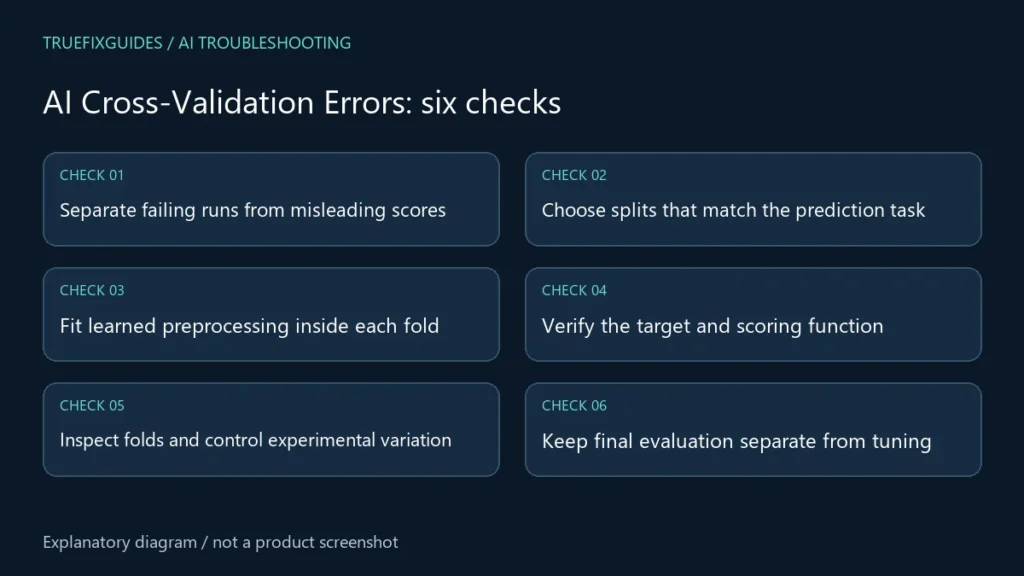
AI cross-validation errors include exceptions during evaluation and misleading scores from an evaluation that appears to succeed. Treat these as separate problems. First reproduce the failure on a small example, then check whether your data split and scoring procedure represent the prediction task you actually intend to deploy. For AI cross-validation errors, the safest starting point is to save the full traceback and each fold score before changing the splitter or model.
1. Separate failing runs from misleading scores
Record the estimator, library version, splitter, scoring function, and full exception when a run fails. Use a small non-sensitive dataset to find the earliest failing step. During diagnosis, configure the evaluation tool to surface the underlying fit error rather than quietly accepting missing scores.
For completed runs, record every fold score and its sample count. Do not rely only on the mean. AI cross-validation errors can hide in one fold with a missing class, a small sample, or a distribution unlike the other folds. Preserve the split indices for inspection.
Begin with a reproducible example that uses the same columns, target shape and splitter settings as the failed run. If sensitive data cannot be shared, create synthetic rows that reproduce the exception. Save the complete traceback, not just the final line. A fitting error, an undefined metric and a data-conversion error require different remedies.
For AI cross-validation errors in scikit-learn, error_score='raise' can surface a fitting exception while you diagnose it; return to a deliberate production setting after the cause is fixed. This option does not make an invalid metric valid, and it does not repair a poor evaluation design. If only one fold fails, compare its class counts, missing values, groups and time range with the successful folds.
2. Choose splits that match the prediction task
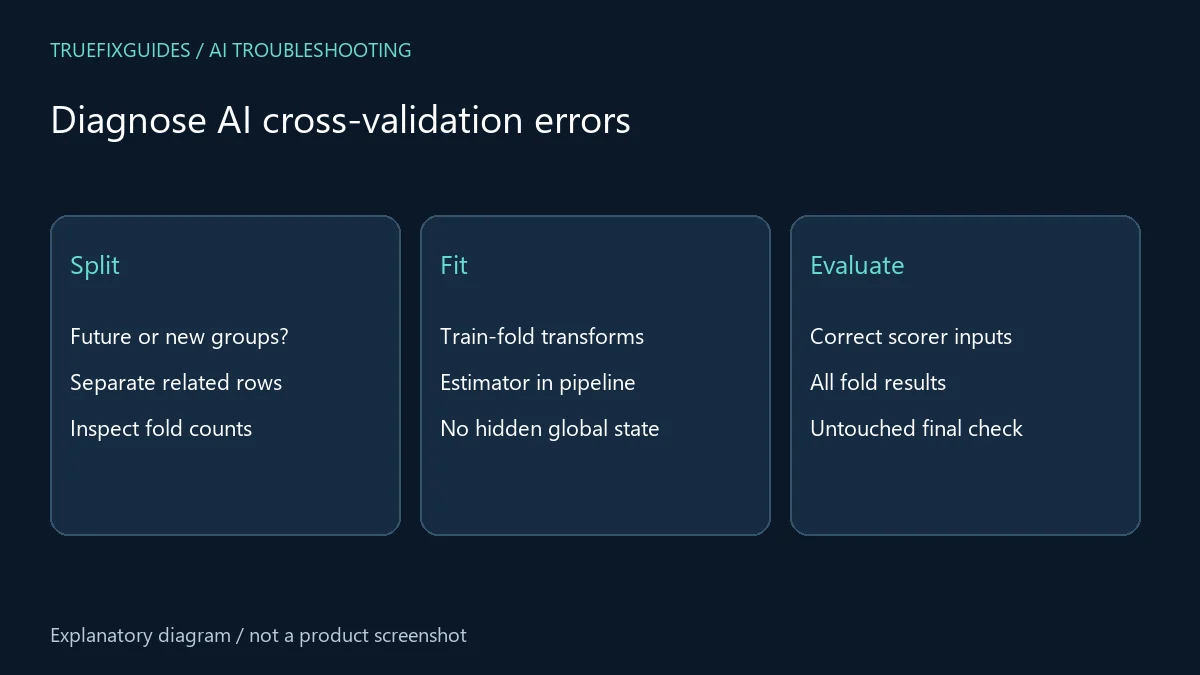
Determine what must remain unseen: a new row, a new person, a new organization, or a future time period. Related observations may need to stay together. Forecasting generally needs evaluation on later observations rather than random mixing of past and future.
The scikit-learn cross-validation guide describes splitters for different data structures. Select the splitter from the use case, not habit. Prevent AI cross-validation errors by writing down what generalization claim each split supports and what it cannot establish.
Suppose you have many rows per customer and the deployed model will predict for new customers. A row-level random split can place the same customer’s pattern in both training and validation. A group-aware split asks a more relevant question. If the deployed model forecasts next month, chronological validation is more appropriate than shuffling months together. These choices can substantially change the score without changing the algorithm.
For AI cross-validation errors involving time, check whether feature windows end before the prediction timestamp. Some time-series designs need a gap between training and validation to account for delayed labels or overlapping windows. The TimeSeriesSplit documentation describes its ordering and gap option. A suitable gap depends on the real data process; do not copy an arbitrary value.
3. Fit learned preprocessing inside each fold
Scaling, imputation, feature selection, and learned encoders must be trained using the relevant training fold. Apply the fitted transformation to its validation fold. Fitting those steps on all examples first allows information from the evaluation data into training.
A pipeline helps keep preprocessing with the estimator during evaluation. Inspect custom transformations too: a wrapper cannot prevent leakage hidden in a global lookup or precomputed feature. For AI cross-validation errors involving suspiciously strong results, trace where every learned quantity was fitted.
Split first, then fit the scaler, imputer, encoder or selector on each training fold only. Apply the fitted transformation to that fold’s validation rows. If preprocessing is run once on the whole table before cross-validation, the held-out rows can influence the learned means, categories or selected features. The scikit-learn common-pitfalls guide explains this leakage and recommends pipelines.
AI cross-validation errors may also arise when a custom transformer changes the number or order of columns across folds. Test the transform on a small held-out batch that contains missing values and unseen categories. Preserve feature names and expected shape. For the broader evaluation boundary, see the AI data leakage guide; for derived-field timing and train/serve parity, see the AI feature engineering guide.
4. Verify the target and scoring function
Check that each row’s features still match its target after filtering, sorting, or joining. Confirm the task type and expected target encoding. A scorer may require probabilities, decision scores, or class predictions; these are not interchangeable inputs.
Inspect class coverage in each fold and understand what happens when a metric is undefined. Do not replace every missing score with zero or drop failed folds to improve the average. AI cross-validation errors become easier to explain when the report contains the exact metric, input type, failed fold, and reason the score could not be calculated.
For classification, inspect the unique labels in each fold. A rare positive class can disappear from a small validation fold, making some metrics undefined or misleading. Stratification can help preserve class proportions when its assumptions match the task, but it cannot replace required customer or time separation. With highly imbalanced data, report an appropriate metric and the positive support for each fold.
For AI cross-validation errors involving scoring, confirm whether the chosen scorer expects predicted labels, probabilities or decision scores. Do not change the metric merely to remove an exception. Select it based on the decision the model supports, and document whether larger or smaller values are better. Verify feature and target rows remain aligned after sorting, filtering and joining; a silent row mismatch can produce a plausible but meaningless result.
5. Inspect folds and control experimental variation
Print or save row counts, class counts, group overlap, and time ranges for each split. Check that any grouping constraint holds and that feature construction does not cross the intended information boundary. A few explicit assertions can catch an expensive evaluation mistake early.
Use documented random-state controls where the algorithm supports them, and record package versions and data revisions. Reproducibility helps compare changes, but one fixed seed does not prove reliability. Diagnose AI cross-validation errors before running repeated experiments, then assess variation under an appropriate evaluation design.
Make a fold audit table with sample count, time range, unique groups, class balance, missing-value rate and score. Look for a fold that differs sharply and trace specific examples. A single outlier fold can reflect a real change in the task, an invalid split, or a data-quality defect. Do not discard it just because the average improves without it.
AI cross-validation errors should be diagnosed at the earliest failing operation. If an estimator fails only in one fold, verify it has enough training samples and the required classes. If a scorer fails while fitting succeeds, inspect scorer inputs and output shape. Record the package version and random state so another reviewer can reproduce the same result. A fixed seed stabilizes a run; it does not make the design representative.

6. Keep final evaluation separate from tuning
Repeatedly choosing settings based on the same validation results can overfit the evaluation process. Decide how model selection and final assessment will be separated before comparing many candidates. Preserve a final evaluation set when the project design calls for one, or use an appropriate nested procedure.
Report fold results, uncertainty, selection procedure, and limitations together. Our AI testing guide provides related validation checks. Resolve AI cross-validation errors by correcting the evaluation design and rerunning the complete procedure, not by selecting only the favorable folds.
When hyperparameters are chosen from repeated cross-validation results, those same results are part of development. Keep the final assessment outside that selection loop, or use an appropriate nested procedure where the data and task justify it. If no untouched data remains, report the limitation honestly and gather new evidence before making a strong performance claim.
For AI cross-validation errors discovered after deployment, rerun the full selection process under the corrected split and preprocessing pipeline. Compare the old and new evaluation methods, not just their headline scores. A lower corrected score may indicate the old estimate was optimistic. Update monitoring thresholds and release decisions from the valid estimate.
AI cross-validation errors: decision table
| Symptom | First inspection | Safe next action |
|---|---|---|
| Every fold fails to fit | Full traceback, estimator inputs and target type | Reproduce on a small representative sample |
| One fold fails | Class counts, missing values and train size | Correct the underlying data or split constraint |
| Scores are unusually high | Group overlap, timestamps and preprocessing fit | Rebuild a clean evaluation boundary |
| Scores vary sharply | Per-fold distributions and sample counts | Investigate the outlier and report variation |
| Offline score does not match new data | Deployment population and feature availability | Evaluate with a representative holdout |
This table helps isolate AI cross-validation errors; a score pattern alone does not prove the cause. Keep the evidence for the chosen fix.
Verification checklist
A reliable evaluation record includes the prediction task, split rules, sample and class counts, preprocessing location, metric definition, and individual fold scores. Keep the data revision and random-state settings with it. Mark AI cross-validation errors resolved only after both the execution failure and the validity of the evaluation have been checked. Keep the AI cross-validation errors incident record with the model evaluation report.
Frequently asked questions
Does a fixed random seed solve unstable validation?
No. It makes specified randomized operations reproducible. Small samples, unsuitable splits, label problems, and genuine model variation can still produce unstable estimates.
Why does cross-validation show nan scores?
One or more folds may have failed to fit or the scoring function may be undefined for their data. Inspect the warnings, complete traceback and per-fold class counts. Do not replace missing scores with a convenient number.
Is a single train/test split enough?
It can answer a limited question if the split reflects deployment and remains untouched during selection. Cross-validation can show variation, but neither approach compensates for leakage or an unsuitable population.
Is stratification enough for repeated users or time series?
No. Class proportions are only one consideration. Preserve required group separation and time ordering according to the deployment task. Choose an evaluation design that satisfies the relevant constraints.
Editorial note: Revised with AI assistance using the linked primary sources, reviewed November 23, 2026 against current scikit-learn documentation. Diagrams explain the workflow; no hands-on testing of a specific system is claimed.