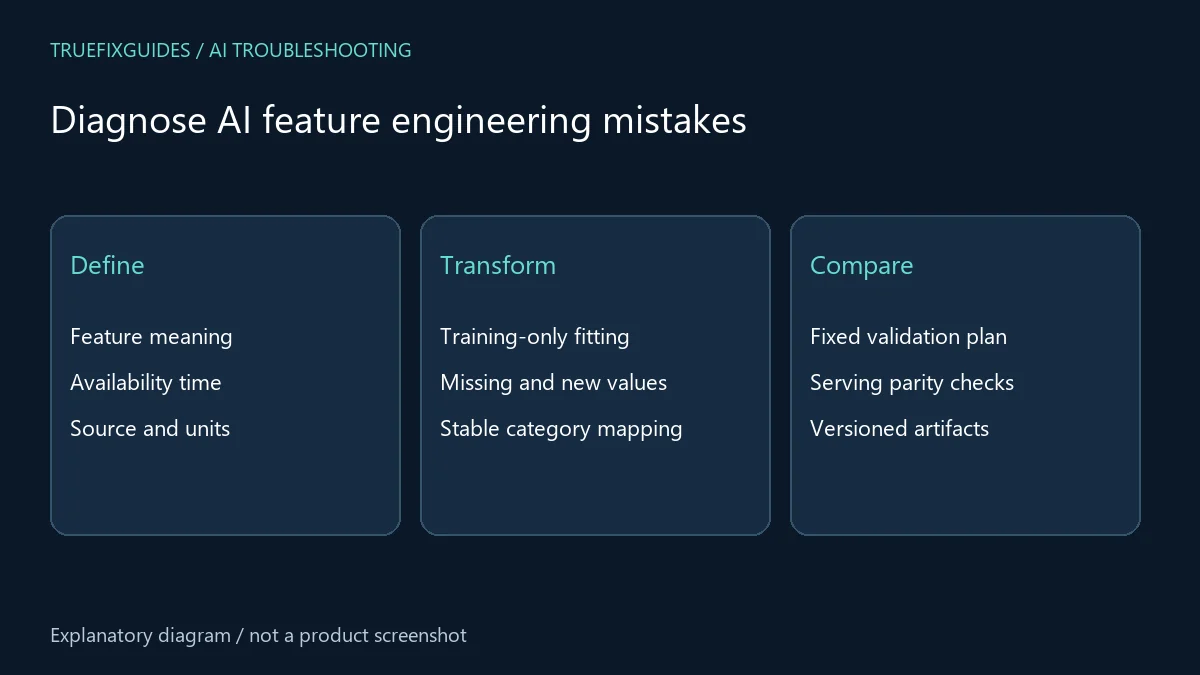
AI feature engineering mistakes can produce impressive development scores and disappointing real-world predictions. Start by checking whether each feature is available at prediction time and whether training and serving calculate it the same way. Then evaluate transformations with a fixed validation plan instead of adding complexity until a score improves. A useful first test is to select one historical prediction, write down exactly what the system knew at that time, and recalculate the features from only that information.
1. Check feature meaning and availability
Describe what each feature measures, where it comes from, and when it becomes available. Watch for outcome-related fields created after the decision you are trying to predict. Inspect joins and historical aggregates rather than assuming a column is safe because its name looks harmless. For a churn model scored on Monday, for example, a support ticket created on Wednesday cannot be a Monday feature. A rolling 30-day count must end at the prediction timestamp, not at the time the training table was generated.
AI feature engineering mistakes involving time are often silent: the model trains and validates with excellent metrics, then fails on genuinely new records. Ask whether each value could have been computed when the prediction would be made. Test a few dated records manually, including one at a month or daylight-saving boundary. A mismatch between event time and processing time can leak future events into an apparently historical aggregate.
AI feature engineering mistakes often begin with a mismatch between an operational concept and the available measurement. Ask a domain expert to review ambiguous variables. Keep a small set of records with manually calculated expected features so you can compare the implemented logic with the intended meaning. Save a definition for each derived field: source, unit, timestamp rule, missing-value rule and owner. That definition makes it possible to distinguish a real change in the data from a coding mistake. For a broader leakage diagnosis, see the AI data leakage guide.
2. Apply scaling where the model needs it
Check the assumptions of your estimator before selecting a transformation. Distance-based and regularized methods can be sensitive to feature scales, while the same scaling is not universally necessary for every model. Units and outliers also affect the choice.
The scikit-learn preprocessing guide describes available transformations and their behavior. Fit learned transformation parameters using training data, then apply them consistently. The scikit-learn common-pitfalls guide specifically warns against fitting preprocessing on test data and recommends a Pipeline for train-only fitting. For AI feature engineering mistakes in cross-validation, each fold must learn its scaler or selector from that fold’s training portion, not from the full dataset. Correct AI feature engineering mistakes by comparing a justified transformation against the baseline, not by standardizing every field without reviewing its meaning. Compare one model with and without the justified scaler under the same split and metric. A change that improves one fold but harms important groups or later periods needs investigation, not an automatic release.
3. Treat missing values as a modeling decision
Inspect where values are missing and whether the reason differs across sources or time periods. A missing measurement can mean “not recorded,” “not applicable,” or a system failure; those cases may need different handling. Avoid replacing every missing value with zero without considering what zero means. A zero revenue amount is different from revenue that was never observed. Missingness itself may carry information, but it can also reveal a data-pipeline outage or a post-outcome process. Check which groups and time periods contain missing values before choosing an imputation rule.
For AI feature engineering mistakes caused by imputation, fit the imputer on training data within the pipeline. Then test a row with a missing value at serving time and confirm it produces the same feature shape and interpretation. The scikit-learn documentation notes that fully empty columns can be dropped by default in some imputers; verify the output schema when a whole field is missing in a fold.
scikit-learn’s imputation documentation explains several approaches. Evaluate an appropriate method within the training procedure and test behavior when serving data contains new missingness patterns. AI feature engineering mistakes can be hidden by a cleaning step that silently drops important groups of records.
4. Encode categories with a serving plan
Choose an encoding appropriate for the estimator and the field. Determine how unseen categories, rare values, and missing categories will be handled. Preserve the fitted vocabulary and ordering with the model instead of rebuilding them independently in production. For example, assigning integers to categories in alphabetical order during training but in arrival order during serving changes their meaning even if every array has the same length. Check that one known category produces the same encoded columns in both paths.
AI feature engineering mistakes with unseen categories need a deliberate policy. Decide whether a new value maps to an “unknown” bucket, triggers a validation error, or prompts a model update. Test that policy in a staging environment. If the source data contains free text or user-generated labels, the set of possible categories can change quickly; monitor unknown-value rates after release.
For encodings that use target information, follow a procedure that prevents an example’s own outcome from leaking into its evaluated features. Test unfamiliar values explicitly. AI feature engineering mistakes can occur without a crash when the same numeric code means different categories in training and serving. Inspect transformed examples on both sides.
5. Evaluate added features against a fixed baseline
Add a small, justified group of features at a time. Record the hypothesis, validation change, complexity cost, and effects on important error cases. Feature selection belongs inside the model-building procedure, not in a preliminary pass that can see the final evaluation labels. Scikit-learn’s common-pitfalls chapter gives a direct example of feature selection before the train/test split producing an overly optimistic score. For AI feature engineering mistakes in experimentation, split data before fitting transforms, select features inside cross-validation, and keep a final untouched evaluation set appropriate to the project.
A higher score after many experiments may reflect selection over the validation set. Keep a separate final assessment appropriate to the project. If the task is time-dependent, consider whether a random split makes the evaluation unrealistic; a later time period may better represent deployment. If records from one customer or device appear in both training and test sets, a grouped split may be needed. Choose the split to match the actual prediction setting rather than selecting the one that gives the highest score. AI feature engineering mistakes are easier to identify when every experiment has a traceable feature set and the team retains results that did not improve performance.

6. Verify training and serving parity
Compare a small batch of identical raw records through training and production feature code. Check column order, types, units, timezone handling, category mapping, missing-value behavior, and model artifact versions. Any intended difference should have an explicit explanation. For AI feature engineering mistakes discovered after deployment, take one safely redacted record, run it through the offline pipeline and the live feature service, and compare each intermediate field. A disagreement in a timestamp, unit conversion, imputation value or column order can be more informative than the final prediction difference alone.
Keep transformation logic and fitted artifacts versioned with the model. Monitor schema changes and unexpected feature distributions after deployment. Alert on missing columns, type changes and a sharp rise in unknown categories, but review false positives and privacy requirements. Keep the model, preprocessing artifacts and feature definitions in a versioned release. If an emergency rollback is needed, restore the compatible model and feature pipeline together; swapping only the model can leave the original mismatch in place. Our environment mismatch guide helps diagnose related failures. Close AI feature engineering mistakes only after the corrected features are verified in the actual serving path.
AI feature engineering mistakes: decision table
| Observed problem | Likely feature issue | First safe check |
|---|---|---|
| Validation is excellent; production is poor | Leakage or train/serve mismatch | Check availability time and replay a dated record |
| Some categories fail only in production | Unseen value or changed encoding | Compare fitted vocabulary and unknown-value policy |
| Shape changes between training and serving | Missing column or dropped feature | Compare output schema after imputation and encoding |
| Cross-validation varies sharply | Split, sample size or transform fitting | Inspect whether each fold fits transforms independently |
| One group has worse results | Source coverage or feature meaning | Compare missingness and errors by relevant group |
Do not release a correction merely because one score rises. For AI feature engineering mistakes, confirm that the new feature can be computed at prediction time, that preprocessing is fitted only on training data, and that the same transformation reaches production. Record both improvements and regressions. Keep a short incident record when AI feature engineering mistakes recur.
Verification checklist
Before release, review feature definitions, availability times, fitted transformation artifacts, category handling, and missing-value behavior. Compare known records between training and serving and keep a separate final assessment. Document unresolved AI feature engineering mistakes with an owner and a reproduction so later model changes do not conceal the same defect.
Frequently asked questions
Does adding more interaction features always help?
No. Additional features can add noise, increase variance, and make serving more complex. Start from a clear hypothesis and compare the change with a fixed evaluation procedure.
Can a pipeline prevent every feature mistake?
No. It can organize fitted transformations, but it cannot determine whether a field exists at prediction time or whether a custom join uses future information. Those need explicit checks.
Should every feature be scaled?
No. Scaling depends on the estimator and the feature’s meaning. Compare a justified transformation under a fixed evaluation plan, then save the fitted transformer with the model.
Why did a new feature improve validation but not production?
Check whether the feature used future information, whether the validation split represented deployment, and whether serving computes the same value. An improvement on one split is not proof of a real-world gain.
Editorial note: Reviewed November 23, 2026 against scikit-learn’s preprocessing, imputation, pipelines and common-pitfalls guidance. Diagrams explain the workflow; no hands-on testing of a specific deployment is claimed.