iCloud backup vs computer backup is not a single-winner contest. Choose iCloud Backup for automatic, wireless protection that works without connecting to a computer. Choose an encrypted computer backup for a fast local restore and broader protection of sensitive categories. The safest plan uses both on a sensible schedule. The correct decision depends on the device, workload, compatibility requirements, privacy expectations, recovery options, and what must keep working after the change.
This iCloud backup vs computer backup guide gives a direct answer first, then compares the choices across practical criteria. It is written for readers who need to choose, troubleshoot, or migrate safely. It does not invent laboratory scores or claim hands-on testing that was not performed.
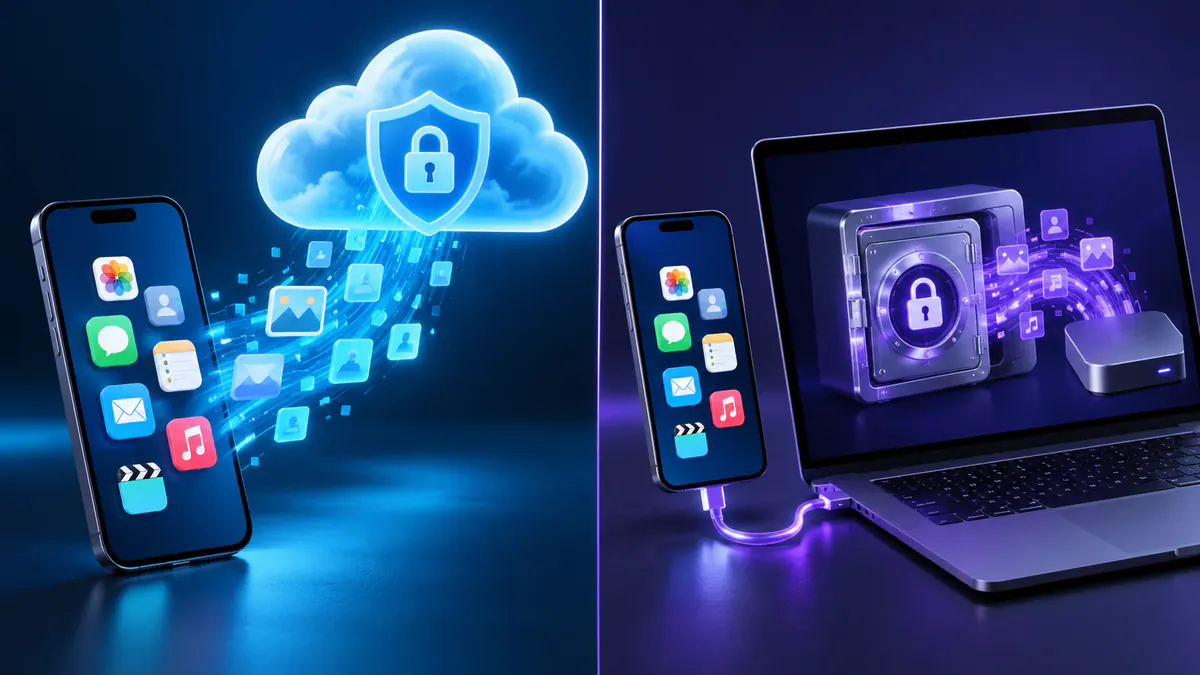
Table of contents
iCloud backup vs computer backup: quick verdict
Choose iCloud Backup for automatic, wireless protection that works without connecting to a computer. Choose an encrypted computer backup for a fast local restore and broader protection of sensitive categories. The safest plan uses both on a sensible schedule.
| Choose iCloud Backup | Choose a Mac or Windows computer backup |
|---|---|
| you need automatic protection away from a desk | you need a local recovery copy |
| you do not regularly connect the iPhone to a computer | internet upload speed is limited |
| you can maintain enough iCloud storage and reliable Wi-Fi | you can protect the computer and retain the encrypted-backup password |
If the iCloud backup vs computer backup recommendation still feels close, rank the criteria that can block the task: compatibility first, then data safety and recovery, then required features, reliability, support, and total cost. Cosmetic preferences should break a tie, not override a hard requirement.
How this comparison was made
The iCloud backup vs computer backup assessment uses documentation-based feature, compatibility, safety, privacy, recovery, and workflow comparison; no sponsored placement and no claim of hands-on benchmark testing. Claims are limited to behavior documented by the vendors or standards bodies linked below, plus conservative troubleshooting principles that preserve data and settings.
This iCloud backup vs computer backup article is not a paid placement, and no winner was selected for affiliate value. Prices, plan limits, model names, firmware, operating-system menus, and supported features can change. Check the current official page before purchasing hardware, changing a subscription, or using a destructive recovery option.
A fair iCloud backup vs computer backup trial holds variables constant. Use the same input, file set, network, accessory, task length, and success test. Measure whether the task finishes correctly, how much correction it needs, what breaks, how recovery works, and whether the result can be repeated.
What iCloud Backup and a Mac or Windows computer backup actually do
iCloud Backup is one side of the decision because it emphasizes: stored in apple’s cloud service. It should be evaluated in the context of you need automatic protection away from a desk; you do not regularly connect the iPhone to a computer; you can maintain enough iCloud storage and reliable Wi-Fi. Its advantage disappears if the required device, account, driver, file system, protocol, or recovery path is unsupported.
a Mac or Windows computer backup emphasizes: stored on the selected mac or windows pc. It is the stronger candidate when you need a local recovery copy; internet upload speed is limited; you can protect the computer and retain the encrypted-backup password. Confirm the exact product version and configuration, since a familiar name does not guarantee identical capability on every platform.
Side-by-side comparison
| Criterion | iCloud Backup | a Mac or Windows computer backup | Practical edge |
|---|---|---|---|
| Location | Stored in Apple’s cloud service | Stored on the selected Mac or Windows PC | Different failure domains |
| Automation | Can run automatically while locked, powered, and on Wi-Fi | Usually requires a connection and a deliberate backup | iCloud |
| Storage limit | Uses available iCloud storage | Uses available computer storage | Computer for large local capacity |
| Encryption | Encrypted in transit and at rest | Encrypt local backup must be enabled for protected categories and passwords | Configuration dependent |
| Restore without computer | Can restore during setup with internet access | Requires the computer containing the backup | iCloud |
| Restore speed | Depends heavily on internet speed and cloud downloads | Local transfer can be faster | Computer |
| Backup access | Tied to Apple Account access | Tied to the computer file and encryption password | Different risks |
| Redundancy | Protects against computer loss | Protects against account or cloud access problems | Use both |
| Verification | Check last successful backup in Settings | Check backup date and manage backups in Finder or Apple Devices | Tie |
1. Location
iCloud Backup: Stored in Apple’s cloud service. a Mac or Windows computer backup: Stored on the selected Mac or Windows PC. Practical edge: Different failure domains. This distinction matters when a decision must survive normal day-to-day use, not just a one-minute setup test. Record the observed comparison result rather than assuming every version behaves alike.
2. Automation
iCloud Backup: Can run automatically while locked, powered, and on Wi-Fi. a Mac or Windows computer backup: Usually requires a connection and a deliberate backup. Practical edge: iCloud. Treat this as a workflow requirement rather than a marketing checkbox, because configuration can change the practical result. Record the observed comparison result rather than assuming every version behaves alike.
3. Storage limit
iCloud Backup: Uses available iCloud storage. a Mac or Windows computer backup: Uses available computer storage. Practical edge: Computer for large local capacity. Use the same device, connection, workload, and success criteria when testing this point so the comparison remains fair. Record the observed comparison result rather than assuming every version behaves alike.
4. Encryption
iCloud Backup: Encrypted in transit and at rest. a Mac or Windows computer backup: Encrypt local backup must be enabled for protected categories and passwords. Practical edge: Configuration dependent. The right choice depends on the failure you are preventing and the recovery path you can actually support. Record the observed comparison result rather than assuming every version behaves alike.
5. Restore without computer
iCloud Backup: Can restore during setup with internet access. a Mac or Windows computer backup: Requires the computer containing the backup. Practical edge: iCloud. Document this requirement before paying, formatting, resetting, or moving important data; it is expensive to discover it later. Record the observed comparison result rather than assuming every version behaves alike.
6. Restore speed
iCloud Backup: Depends heavily on internet speed and cloud downloads. a Mac or Windows computer backup: Local transfer can be faster. Practical edge: Computer. A product or feature update can change this detail, so verify the linked official documentation at the time of setup. Record the observed comparison result rather than assuming every version behaves alike.
7. Backup access
iCloud Backup: Tied to Apple Account access. a Mac or Windows computer backup: Tied to the computer file and encryption password. Practical edge: Different risks. For managed equipment, an administrator policy can override the consumer behavior described here. Record the observed comparison result rather than assuming every version behaves alike.
8. Redundancy
iCloud Backup: Protects against computer loss. a Mac or Windows computer backup: Protects against account or cloud access problems. Practical edge: Use both. If both options meet the requirement, let the next criterion decide instead of over-weighting a theoretical advantage. Record the observed comparison result rather than assuming every version behaves alike.
9. Verification
iCloud Backup: Check last successful backup in Settings. a Mac or Windows computer backup: Check backup date and manage backups in Finder or Apple Devices. Practical edge: Tie. A controlled trial is more reliable than specifications alone when accessories, drivers, accounts, or network conditions are involved. Record the observed comparison result rather than assuming every version behaves alike.
Choose iCloud Backup when
- You need automatic protection away from a desk. This is the strongest signal because it describes the main workflow rather than a rare edge case.
- You do not regularly connect the iPhone to a computer. Confirm this requirement with the actual device, account, or application before committing.
- You can maintain enough iCloud storage and reliable Wi-Fi. Keep the alternative available until the first complete real-world task succeeds.
Choose a Mac or Windows computer backup when
- You need a local recovery copy. This use case gives the option a meaningful operational advantage.
- Internet upload speed is limited. Test the feature with current software and normal security controls enabled.
- You can protect the computer and retain the encrypted-backup password. Plan how data, settings, and credentials will move if the choice later changes.
a Mac or Windows computer backup deserves the same evidence standard. Verify the complete workflow rather than a demonstration, including authentication, import or transfer, output quality, reconnection after restart, and recovery after one deliberate failure test.
Safe evaluation and switching plan
Before changing anything in the iCloud backup vs computer backup decision, make a recoverable baseline. Save configuration, export data where supported, record versions, keep recovery credentials, and photograph physical cable or port layouts when relevant.
- Step 1: Check the date of the latest iCloud backup. Write the baseline down so memory is not the only record.
- Step 2: Connect the iPhone to a trusted computer and open Finder or Apple Devices. Do not remove the current working option yet.
- Step 3: Enable encrypted local backup and store the password in a password manager. Use non-sensitive sample data for the first trial.
- Step 4: Run the backup and confirm its timestamp. Compare the result with the original acceptance criteria.
- Step 5: Periodically verify both copies before installing major updates or replacing the phone. Keep the rollback materials until several normal tasks succeed.
Safety warning: A forgotten encrypted-backup password can make a computer backup unusable. A backup is also not the same as syncing: deleted or corrupted synced content may propagate, so keep independent copies of irreplaceable files. Stop if the test threatens the only copy of data, requires an unknown command, removes account recovery, weakens network security, or selects a disk or device you cannot positively identify.
Troubleshooting the choice
If iCloud Backup works but a Mac or Windows computer backup does not, compare prerequisites before assuming a defect. Check version, account entitlement, operating-system support, firmware or driver level, available memory or storage, network policy, permissions, and the exact input used.
If neither iCloud backup vs computer backup side works, return to a known-good baseline. Test a second cable, device, account, network, file, or small workload where relevant. The shared failure often sits outside the comparison—for example, a damaged source file, expired credential, blocked port, failing storage device, or service outage.
If both work but results vary, repeat the same task at least three times and note latency, errors, reconnections, manual corrections, power or resource use, and recovery. For iCloud backup vs computer backup, stability across ordinary use is more valuable than one unusually fast run.
When neither option is right
Do not force the iCloud backup vs computer backup choice when a third path better matches the requirement. An official repair tool, a managed enterprise service, a different storage format, a wired connection, a verified backup, a supported adapter, or professional recovery may be safer than either option.
- Neither option supports the required device, operating system, account policy, or data format.
- The only copy of important data would be placed at risk.
- A physical fault, service outage, or carrier or administrator restriction is the real blocker.
- The task requires compliance, accessibility, support, or security controls that neither option documents.
- The expected benefit is smaller than the migration cost and the current setup is stable.
Frequently asked questions
Which is better in iCloud backup vs computer backup?
Choose iCloud Backup for automatic, wireless protection that works without connecting to a computer. Choose an encrypted computer backup for a fast local restore and broader protection of sensitive categories. The safest plan uses both on a sensible schedule. “Better” should mean the option that meets the required workflow with acceptable risk, compatibility, recovery, and cost—not the option with the longest feature list.
Can I use iCloud Backup and a Mac or Windows computer backup together?
In a iCloud backup vs computer backup workflow, sometimes—but not always. They may complement one another, serve different devices, or create conflicting settings. Check official support boundaries, avoid duplicate background services, and test one controlled workflow before combining them.
Is iCloud Backup safer than a Mac or Windows computer backup?
Safety depends on configuration, updates, account protection, data handling, and the exact failure being avoided. A forgotten encrypted-backup password can make a computer backup unusable. A backup is also not the same as syncing: deleted or corrupted synced content may propagate, so keep independent copies of irreplaceable files. A safer choice is the one with a verified backup and a clear rollback path.
How should I test iCloud backup vs computer backup fairly?
For iCloud backup vs computer backup, use the same hardware, data, network, workload, versions, and acceptance criteria. Change one variable at a time, repeat a representative task, and record failures as well as speed. A one-time best result is not dependable.
Should I switch immediately after reading this comparison?
Do not switch the iCloud backup vs computer backup setup immediately. Preserve the current working state, confirm compatibility, and complete a small reversible trial first. Move important data only after the replacement passes the full task.
Official sources and related guides
The iCloud backup vs computer backup facts above were checked against these primary documentation and standards resources. Follow the current vendor instructions when an interface or supported-version list differs from the description.
Continue with the relevant TrueFixGuides resources:
- Fix an iPhone update that will not download
- Fix phone charging problems
- Fix Apple Account login problems
Conclusion
For iCloud backup vs computer backup, choose from the real constraint rather than the product name. Choose iCloud Backup for automatic, wireless protection that works without connecting to a computer. Choose an encrypted computer backup for a fast local restore and broader protection of sensitive categories. The safest plan uses both on a sensible schedule. Preserve a rollback path, test with representative work, and keep the option that produces a correct, repeatable result without unacceptable risk.


